
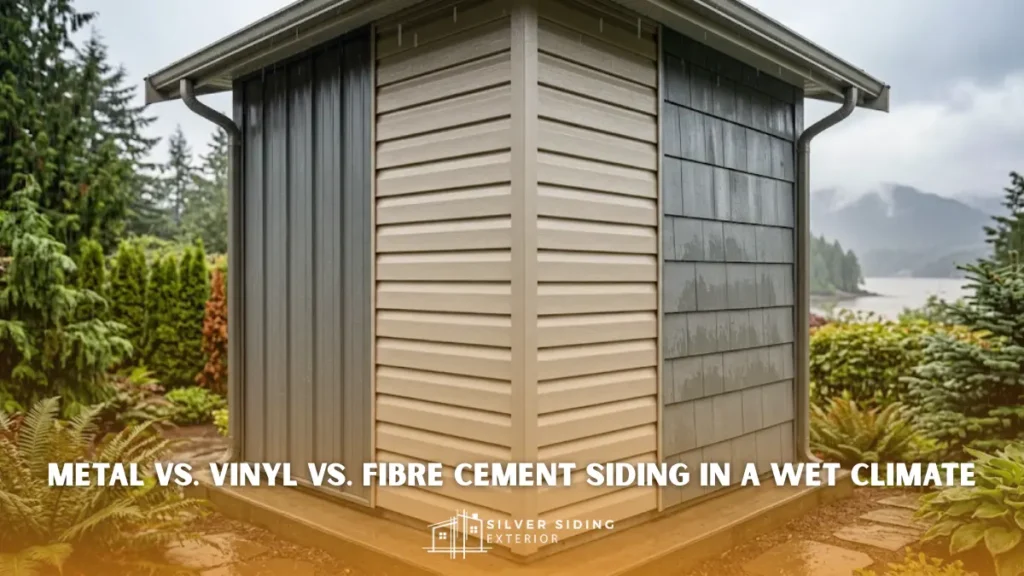
Best Siding for Rainy Coastal Climates (Summary)
Here is the short version before the detail.
- Fibre cement is the strongest all-round performer in sustained rain. It has no organic material for mould to feed on. It stays dimensionally stable when wet.
- Metal is the strongest performer on longevity and drying speed. That holds only when the alloy, coating and fasteners are specified for a marine-influenced environment.
- Vinyl is the strongest performer on budget, and it is genuinely rot-proof. It is also the least forgiving of poor detailing and the least durable against UV and impact over decades.
And here is the part nobody selling siding likes to lead with. In a coastal climate, installation quality and the drainage cavity behind the cladding matter more than which of these three materials you pick. A perfectly chosen board over a badly built wall will still fail.
What Damages Coastal Siding
“Rainy” is too vague to design around. On the coast, six separate forces work on your walls. Each material responds to them differently.
- Wind-driven rain. Water does not just fall on the wall. It is pushed sideways into laps, joints and window heads under pressure.
- Low drying potential. Months of overcast, humid weather mean a wall that gets wet may not dry before it gets wet again.
- Biological growth. Moss, algae and mould colonise damp, shaded north-facing elevations regardless of the material.
- Salt aerosol. Near the water, airborne salt settles on surfaces and holds moisture against them. It accelerates corrosion of anything metallic, including fasteners buried inside the wall.
- UV and thermal cycling. Even a grey climate delivers enough UV and temperature swing to fade pigments and move panels.
- Freeze–thaw. Mild here, but real. Water sitting in an absorbent material that then freezes will do damage over time.
Notice how many of those are about water that has already got past the siding. That is the whole point of the next section.
The Wall Behind the Cladding
In coastal British Columbia this is not a philosophical point. It is law. And it exists because of a very expensive lesson.
The leaky-condo crisis of the 1990s was caused by face-sealed walls that assumed no water would ever get in. When it inevitably did, there was nowhere for it to drain and no air movement to dry it out. If you want the full picture of how a rainscreen wall works, layer by layer, we cover it in a separate guide.
The response was the rain screen system. It is a drained, vented air cavity between the cladding and the sheathing membrane. The City of Vancouver’s building bulletin sets out the mechanics plainly: a drained cavity (10 mm in that 2009 bulletin; current code sets the minimum at 9.5 mm) that is at least 80% open, vented to the outside with insect screens, with the cladding acting as the first plane of protection and the membrane behind it as the second (City of Vancouver rainscreen bulletin, PDF).
Two rules worth knowing before you choose a material
- At the provincial level, the BC Building Code has required rainscreen (capillary-break) construction in coastal climate zones since 2006. Coastal municipalities moved earlier still: Vancouver, Richmond and New Westminster adopted rainscreen requirements in the late 1990s.
- Specifically within the City of Vancouver, the building bulletin requires a rainscreen on all new one- and two-family dwellings as of 1 May 2007, regardless of house size. Vinyl and aluminium siding are named exceptions, because both are inherently vented and free-draining by design.
So the “1 May 2007” date is a City of Vancouver bulletin milestone, not the origin of the provincial rule. The province was already ahead of it. Confirm the exact requirement with your local authority having jurisdiction, since municipalities across Metro Vancouver interpret and inspect the details differently.
That vinyl and aluminium exception explains more about real-world performance than any product brochure. Vinyl is not exempt because it is better. It is exempt because it hangs loosely and drains behind itself by nature.
Fibre cement, by contrast, is a dense, low-permeability board. That is exactly why the cavity, the weather-resistive membrane behind the cladding, and correctly prepared window and door openings carry so much of the load. Openings are where coastal walls leak, not the middle of the field.
Vertical strapping, not diagonal
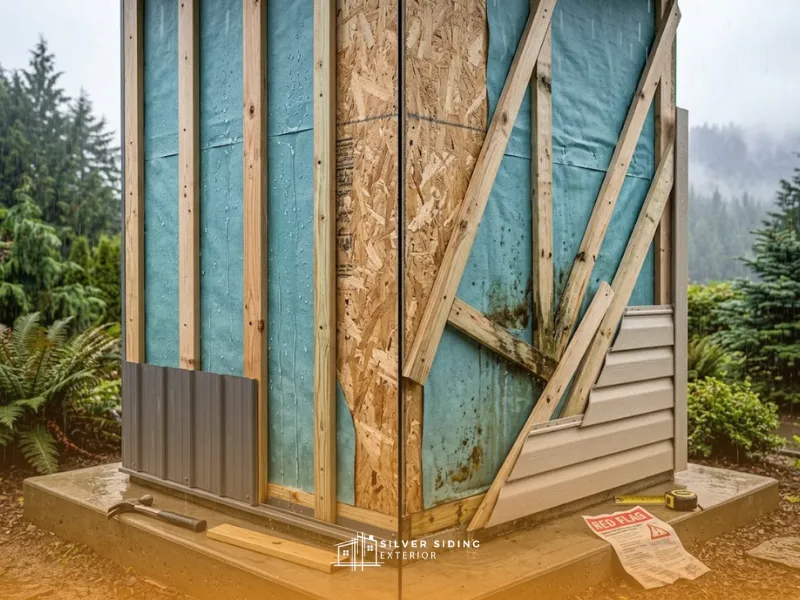
One detail trips up even experienced crews. The drainage cavity only works if water can actually run down and out of it. That means the strapping behind the cladding must run vertically, giving gravity a clear, unobstructed path to the bottom of the wall.
Diagonal strapping is an outdated approach. It obstructs drainage and encourages water to sit against the sheathing membrane. In practice it is not accepted under Vancouver’s rainscreen detailing, which calls for a nominally vertical drainage path. If a contractor proposes angled or diagonal furring to “save material,” treat it as a red flag.
Metal vs. Vinyl vs. Fibre Cement Compared
A single ten-row table is unreadable on a phone, so here is each material on its own card. Cost is shown as a relative tier, from $ (lowest installed cost) to $$$ (highest).
Metal (steel / aluminium)
- Water absorption: none.
- Rot / mould in the material: none — no organic content.
- Salt-air behaviour: the key vulnerability. Depends entirely on alloy, coating and fasteners.
- Impact resistance: dents (aluminium more readily than steel).
- Fire: non-combustible.
- Maintenance: rinse; inspect fasteners and cut edges.
- Relative cost: $$$ — typically the most expensive of the three, often roughly two to three times the installed cost of vinyl.
- Rainscreen cavity (BC, new 1–2 family): aluminium is exempt in Vancouver; steel follows code and manufacturer guidance.
Vinyl (PVC)
- Water absorption: none.
- Rot / mould in the material: none, though surface mildew films are common.
- Salt-air behaviour: not applicable to the panel; fasteners still matter.
- Impact resistance: cracks, especially when cold or aged.
- Fire: poor — softens and melts.
- Maintenance: wash off mildew film; low effort.
- Relative cost: $ — the lowest installed cost, and the baseline the other two are measured against.
- Rainscreen cavity (BC, new 1–2 family): exempt.
Fibre cement
- Water absorption: very low; does not swell or rot.
- Rot / mould in the material: none — no organic content.
- Salt-air behaviour: the board is unaffected; fasteners and flashings still matter.
- Impact resistance: best of the three, though edges can chip.
- Fire: non-combustible.
- Maintenance: wash; repaint eventually unless factory-finished.
- Relative cost: $$ — middle to high, commonly around one and a half to two times the installed cost of vinyl.
- Rainscreen cavity (BC, new 1–2 family): required.
Cost tiers are relative and for orientation only. Real installed pricing depends on your home’s height, access, trim complexity and the condition of the wall underneath.
How Fast Each Material Installs
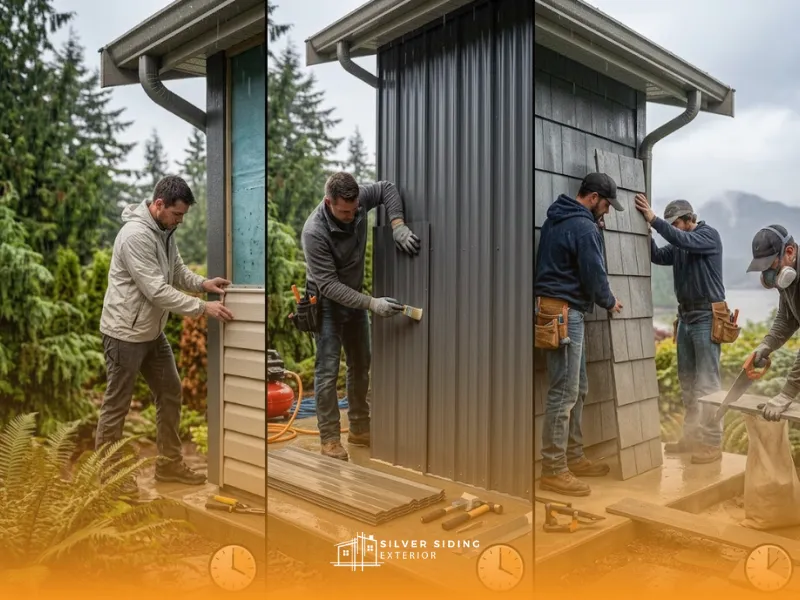
Installation speed is a real cost that rarely makes the brochure. It shows up in labour hours, and in how long your walls are exposed during a wet season.
- Vinyl is the fastest. It is light, cuts with simple tools, and hangs quickly. Fewer labour hours means lower installed cost and less time with the wall open to the weather.
- Metal sits in the middle. Panels are light to handle, but coastal detailing — cut-edge treatment, corrosion-appropriate fasteners, careful flashing — adds time that a rushed crew will be tempted to skip.
- Fibre cement is the slowest and heaviest. Boards are dense and awkward, cutting produces silica dust that must be managed, and every cut edge should be sealed. This is skilled, deliberate work, and it is the material where a fast quote should worry you most.
The takeaway is not “pick the fastest.” It is that a suspiciously quick fibre cement timeline usually means corners are being cut on exactly the steps that keep a coastal wall dry.
Metal is also not a single choice, and the look you are chasing narrows it further. Wide flat panels, dark colours and mixed-material façades each behave differently once they are weathering on a real wall. If you are still shaping the exterior, our overview of this year’s exterior siding trends for wet-climate homes covers those choices before you commit to a profile.
Metal Siding in a Wet Coastal Climate
Metal is the material that most rewards being specified properly, and most punishes being specified casually.
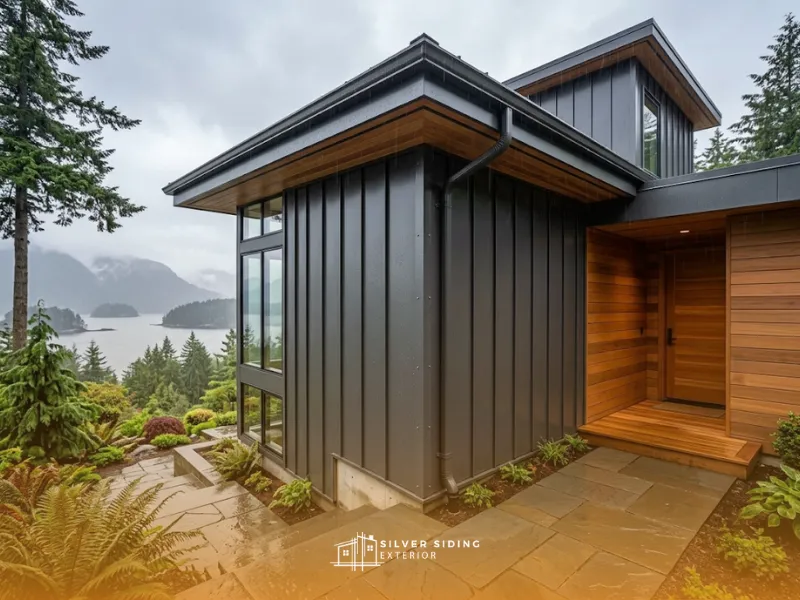
The panel itself is immune to everything a rainy climate does to organic materials. It will not rot, swell, host mould or absorb water. It sheds and dries fast, and it is non-combustible.
Where metal genuinely wins
- Zero water absorption and very fast drying after wind-driven rain.
- Long service life when the coating is right. Factory PVDF-type finishes hold colour far better than lower-grade paints under coastal UV and reflected light.
- Clean modern lines that suit contemporary architecture, including aluminium planks with a realistic wood-grain finish for homeowners who want the cedar look without the cedar maintenance.
- Panel systems such as architectural metal panel cladding integrate naturally with a drained cavity, because they are usually installed on furring anyway.
Where metal struggles
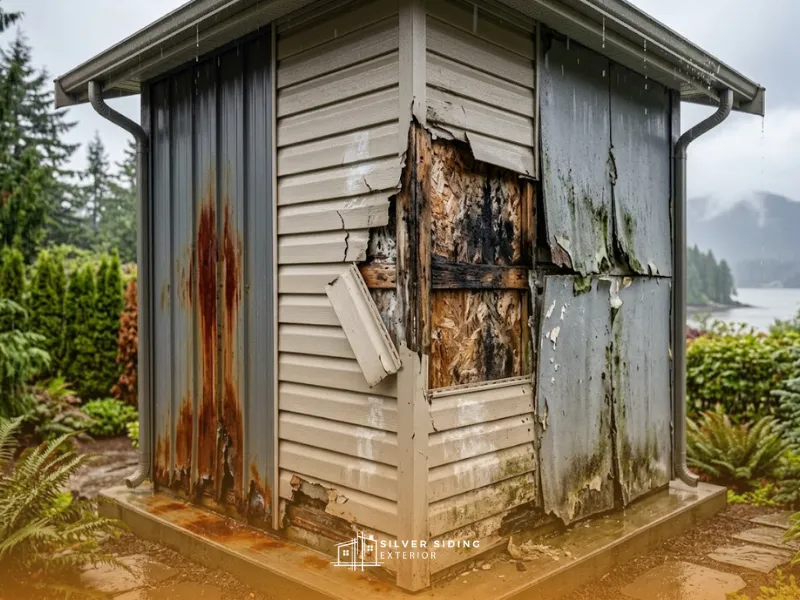
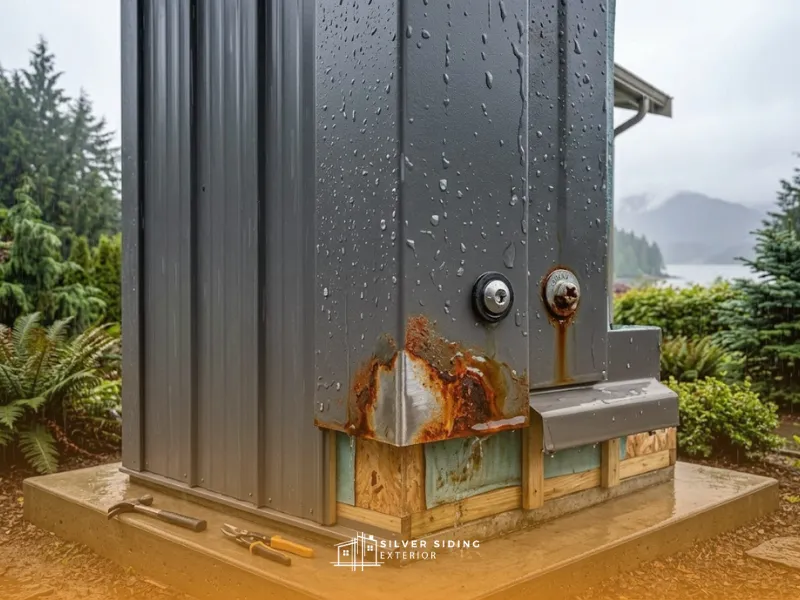
- Corrosion at cut edges, seams and fasteners. Real coastal failures are almost never the panel field. They are the screws, clips and flashings.
- Galvanic corrosion where dissimilar metals touch. This is an installer-knowledge problem, not a product problem.
- Denting from ladders, branches and hail.
- Cost, which is generally the highest of the three.
The cut-edge problem, specifically
Here is a failure mode homeowners rarely hear about until it appears. A metal panel arrives with a factory coating that seals the surface. The moment it is cut to length on site, a raw, unprotected edge is exposed.
In salt air, that raw edge is where corrosion starts. It creeps back under the coating from the cut line, long before the panel face shows any problem. This is why coastal metal work lives or dies on edge treatment and corrosion-rated fasteners.
One homeowner asked exactly this on GreenBuildingAdvisor, and the thread is a useful read: Exterior fastener selection in PNW coastal area. The experienced responses converge on stainless — 316 over 304 in genuinely salty exposure — and on the point that fasteners which stay continuously wet are the ones that fail, not the ones protected inside the assembly.
If you are considering metal siding, the fastener and cut-edge specification deserves as much of your attention as the colour.
Vinyl Siding in a Wet Coastal Climate
Vinyl gets dismissed too quickly by people who have only seen a bad installation.
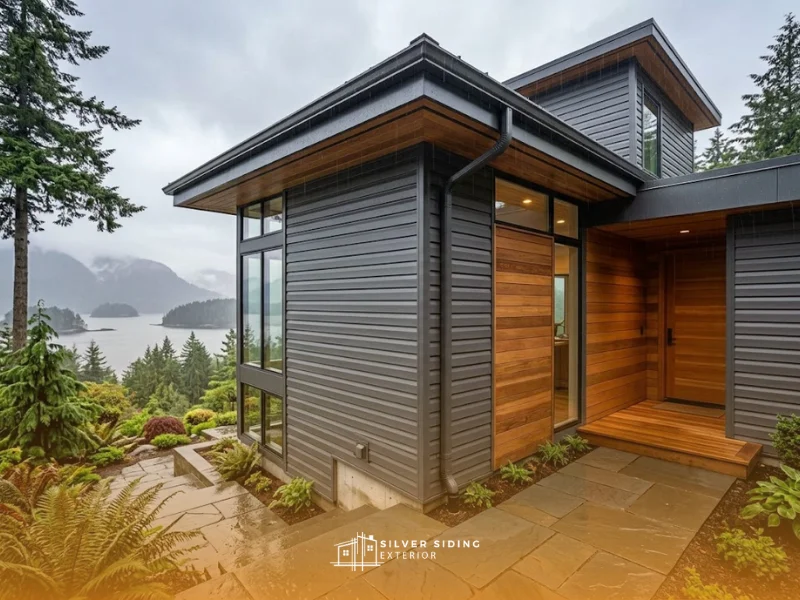
It is genuinely rot-proof, genuinely insect-proof, and — as the Vancouver bulletin confirms — genuinely self-draining. It is also, by a wide margin, the cheapest way to put a durable, water-shedding skin on a house.
Where vinyl genuinely wins
- Lowest installed cost, and the easiest of the three to repair panel by panel.
- It cannot rot or absorb water, so it never needs painting.
- Its loose-hung, vented geometry drains behind itself without a purpose-built cavity. That is the reason it is exempt from the rainscreen requirement.
- Modern profiles are far better than the thin, wavy product that gave vinyl its reputation twenty years ago. If budget is the binding constraint, a well-installed vinyl siding wall in a rainy climate beats a cheap installation of an expensive material every time.
Where vinyl struggles
- Surface mildew and green algae film on shaded, damp elevations. Cosmetic and washable, but it returns.
- Brittleness and cracking with age and cold, and poor impact resistance.
- Fading of darker colours under UV, with no realistic option to repaint.
- Large thermal movement. Nailed tight instead of hung loose, it buckles. This is a very common defect.
- It contributes nothing structurally and nothing to fire resistance.
The coastal windstorm weakness
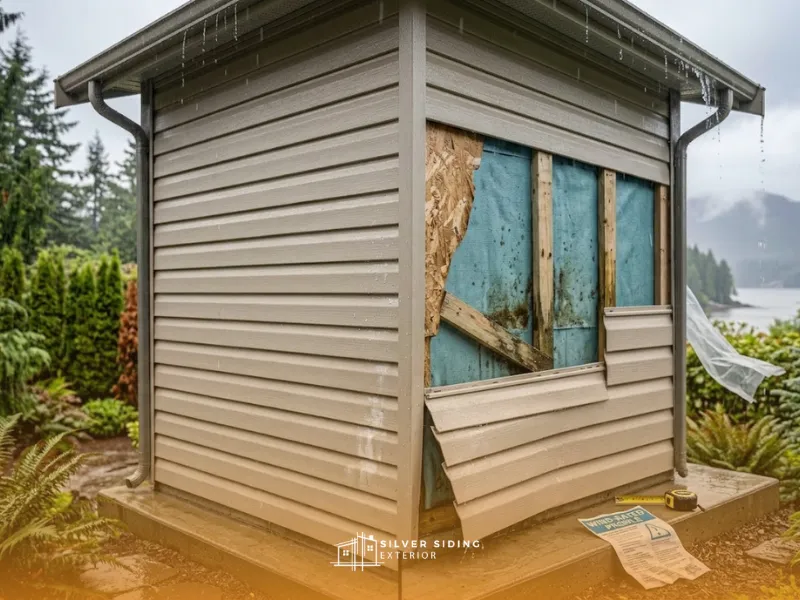
Vinyl’s self-draining design is also its exposure in a storm. The same loose-hung panels that let water and air move behind the wall can catch wind.
On an exposed coastal elevation, a strong gust can get under the bottom lip of a panel and work it loose, or peel a run of siding away entirely. Correct installation reduces the risk — proper locking, correct nailing tension, wind-rated profiles on exposed walls — but the vulnerability is inherent to the format. On the most wind-battered elevations, this is a genuine mark against vinyl.
The most common homeowner question about vinyl in a wet climate has been asked directly on GreenBuildingAdvisor: Is a rain screen ever needed behind vinyl siding? It was posted by a homeowner with few overhangs, little sun and plenty of rain. The consensus is worth repeating: do not spend money on a cavity behind vinyl. Spend it on the water-resistive barrier and on flashing every opening properly. That advice generalises well beyond vinyl.
Fibre Cement Siding in a Wet Coastal Climate
Fibre cement (frequently written “fiber cement”) is cement, sand and cellulose fibre pressed into board.
Because there is effectively nothing in it for mould to eat, and because it does not swell when wet, it has become the default recommendation for rainy regions. That reputation is largely deserved.
Where fibre cement genuinely wins
- Dimensional stability through wet–dry and freeze–thaw cycling.
- No organic food source for mould or rot within the board.
- Non-combustible, and the best impact resistance of the three.
- It looks like painted wood, which matters on traditional West Coast architecture where metal would read as wrong. Both James Hardie fibre cement siding and Allura fibre cement boards offer factory-applied finishes that hold colour far better than site-applied paint in a damp climate.
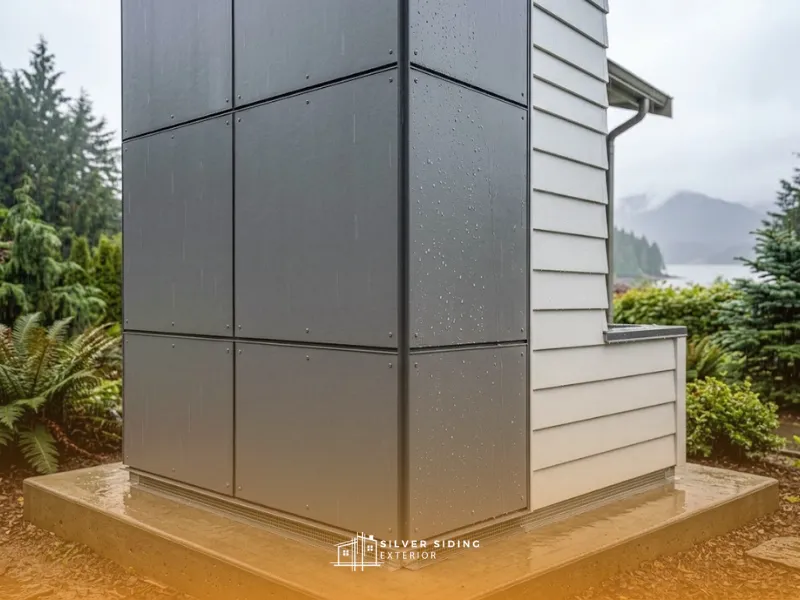
Where fibre cement struggles
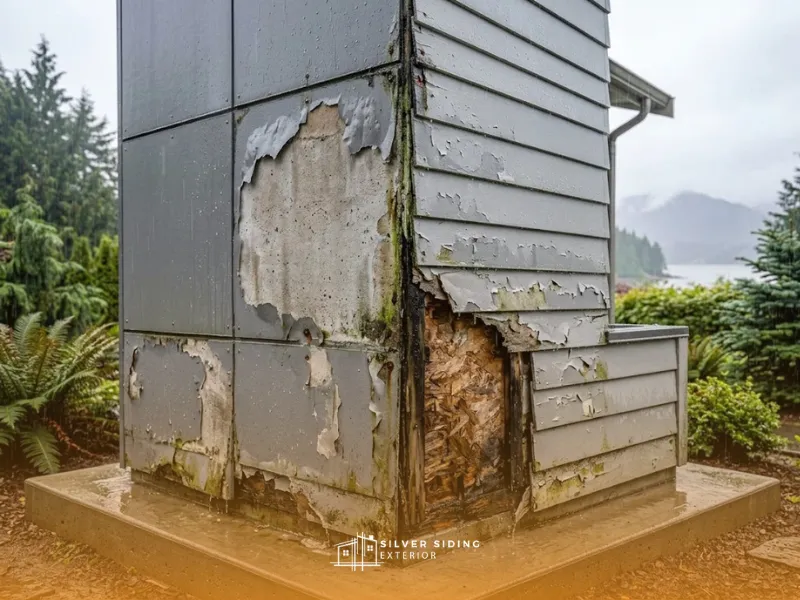
- It is a low-permeability board over a wall that needs to dry. Without a drainage cavity, moisture trapped between the board and the sheathing has nowhere to go. That is precisely why the code here requires one.
- Cut edges must be sealed. This is the single most-skipped step on a rushed fibre cement job.
- Site-painted product will eventually need repainting, and the wet season narrows the window for doing that well.
- It is heavy, and installation is genuinely skilled work.
Does Hardie need a rainscreen over a ZIP wall?
This is one of the most-debated questions in online building forums, and the nuance matters. Modern sheathing systems such as ZIP combine the structural panel and the weather-resistive barrier into one taped board. Some homeowners reasonably ask: if the wall is already sealed and taped, is the drainage gap behind Hardie really necessary?
The building-science answer is that the two layers do different jobs. A taped sheathing system manages the water barrier. The rainscreen gap manages drainage and drying. One does not replace the other.
A homeowner raised exactly this over a panel system, and the exchange is instructive: Necessity for rainscreen approach with Hardiepanel. The consensus is that the siding will probably survive without the cavity, but the sheathing behind it and the paint film on it will both last meaningfully longer with one. And in coastal BC, this is not merely a best-practice debate — for fibre cement, the drainage cavity is required, ZIP or no ZIP.
Metal vs. Fibre Cement
This is the comparison serious renovators actually agonise over, because both are strong choices.
- Choose fibre cement if the house is traditional, if impact resistance matters (kids, ladders, a tight lot), and if you want the lowest-drama material on a mainstream budget.
- Choose metal if the house is modern, if you are within a few hundred metres of salt water and want a material that cannot rot at all, and if you are prepared to pay for the specification that makes it last.
- Both are non-combustible. Both are dimensionally stable. Both need a properly detailed cavity and flashing. Neither is a cure for a badly built wall.
Vinyl vs. Fibre Cement
- Fibre cement wins on impact, fire, appearance, colour longevity and resale perception.
- Vinyl wins on cost, repairability, and — surprisingly — on tolerance of a simpler wall assembly.
The nuance that matters: a properly installed vinyl wall will outperform a poorly installed fibre cement wall in a rainy climate. Unsealed cut edges, missing head flashing and no drainage cavity turn the “better” material into the worse outcome.
Metal vs. Vinyl
- Both are non-absorbent. Both drain behind themselves reasonably well.
- Metal lasts far longer, holds colour better and does not go brittle. It also costs several times more and can corrode at the details.
- Vinyl is the pragmatic choice for a rental, a budget re-clad or a sheltered elevation. Metal is the long-horizon choice for an exposed one.
What Matters More Than the Material
Overhangs and eaves
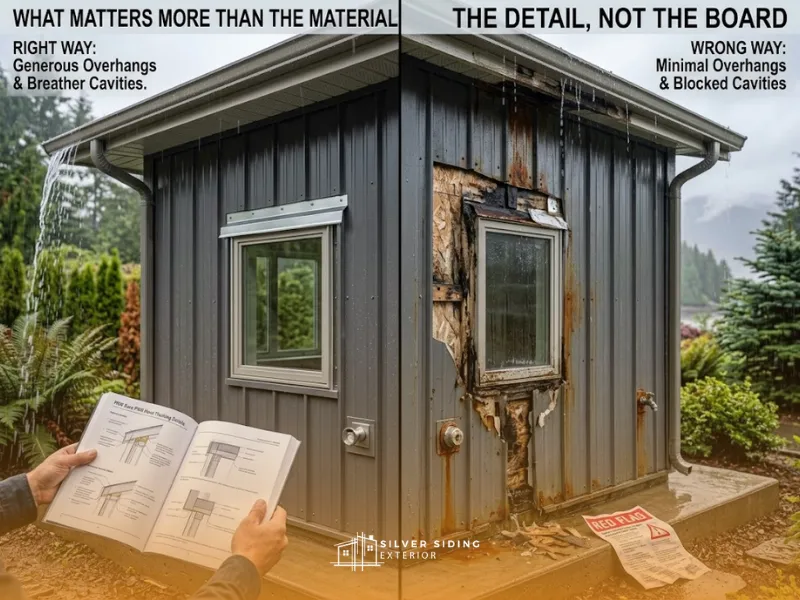
The best siding in a wet coastal climate is the siding that gets rained on least. Generous roof overhangs are the cheapest waterproofing you will ever buy.
The detailing at the eave line matters too. Where soffits and eave ventilation meet the top of the cladding decides whether the rainscreen cavity can actually breathe.
Openings
Walls leak at windows, doors, hose bibs, vents and light fixtures. Every one of those is a hole punched through the drainage plane.
A siding contractor who cannot describe how they detail a window head flashing into the membrane is not going to save you with a better board.
How to Evaluate Your Wall System Before Buying Siding
Before you compare panels and colours, work through the wall itself. Here is the order to do it in.
- Identify your exposure. Note which elevations face north, sit in shade, or lack roof overhangs. These are your highest-risk walls.
- Measure your distance to salt water. Within a few hundred metres, corrosion-rated fasteners and coatings stop being optional for any metal component.
- Confirm the drainage plane. Ask exactly how water that gets past the cladding will drain and dry. If there is no clear answer, stop there.
- Check the strapping direction. It must be vertical, not diagonal, so water runs straight down and out.
- Inspect the openings. Every window, door and penetration should have a described flashing detail that ties into the membrane.
- Verify the membrane is continuous. The weather-resistive barrier behind the cladding is the second line of defence and must not be interrupted.
- Match the material to the architecture and budget. Only now does the metal-versus-vinyl-versus-fibre-cement question belong on the table.
- Vet the installer. Ask them to explain their cavity and flashing details without hesitating. Hesitation is your answer.
Exposure Varies Across Metro Vancouver
The regional climate is one thing. Your wall’s actual exposure is another.
A steep, tree-shaded slope in West Vancouver holds damp on north elevations long after the rain stops, and dries slowly. Older homes across North Vancouver often carry minimal overhangs from an era that assumed face-sealed walls would hold.
Inland conditions in Burnaby mean less salt aerosol but no less rain. Low-lying, wind-exposed sites in Richmond take wind-driven rain from directions a sheltered lot never sees. Even within Vancouver itself, two houses on the same street can age differently depending on which way they face.
If you want to see how these materials look on a real wall in this climate rather than in a manufacturer’s rendering, our project photo gallery is the most useful five minutes you can spend before deciding. You can also compare the full range of exterior cladding options we install side by side.
Where to Go From Here
If you take one thing from this comparison, make it this: choose the wall, then choose the siding.
Decide how the assembly will drain and dry. Decide how the openings will be flashed. Only then argue about panels and colours. Every siding material on this page can succeed in a wet coastal climate, and every one of them can fail. The variable is almost never the box the product came in.
If you are weighing these three materials for a specific home and want a straight assessment of what your elevations, exposure and overhangs actually call for, we are glad to walk through it with you — including telling you when the cheaper material is the right one.
And if the material you land on is metal, the next decision is which metal system fits the wall and the budget. Our guide to choosing between LUX, Longboard and AL13 picks up exactly where this one leaves off.
