Every siding or cladding system relies on what’s underneath it just as much as what’s visible on the outside. A Tyvek air barrier sits between your wall structure and your exterior finish, controlling moisture and air movement before a single panel goes on. It’s not something most homeowners think about — until it’s installed poorly, and the consequences show up years later as rot, mold, or a draft that won’t go away.
At Silver Siding, we install Tyvek air barriers as part of full exterior systems — alongside rain screen assemblies, window preparation, and the siding or panel work itself — for homes, multi-family buildings, and commercial properties across Metro Vancouver. It’s rarely the finishing touch anyone notices, but it’s one of the layers that decides whether the rest of the job holds up.
A Tyvek air barrier is a continuous, non-perforated synthetic membrane installed directly over the wall sheathing, before any rain screen, furring, or cladding goes on. Its job is straightforward but important: stop outside air and bulk water from getting into the wall assembly, while still letting water vapor that’s already inside the wall escape outward.
This combination is what separates Tyvek from a basic plastic sheet or a perforated wrap. When it’s installed as a continuous, properly sealed layer — taped at seams, sealed around penetrations, and integrated with flashing — it functions as an effective air barrier for the building.
This is one of the most common points of confusion we hear from homeowners and builders, and it’s worth answering directly: an air barrier and a vapor barrier are not the same thing, even though both deal with moisture.
An air barrier’s job is to stop the bulk movement of air — drafts, infiltration, and the pressure differences that pull conditioned air out of a building or pull outside air in. A vapor barrier’s job is different: it controls vapor diffusion, the slow movement of water vapor through a material over time, independent of air movement.
Tyvek is designed as an air and water-resistive barrier that is also vapor-permeable. In practical terms, that means it blocks air and bulk water effectively, but it still allows vapor to pass through it — which is the opposite of how a traditional vapor barrier, like interior poly sheeting, is meant to perform. So when someone asks whether Tyvek is an air barrier, the answer is generally yes, provided it’s installed as a continuous, sealed layer. When someone asks whether it’s a vapor barrier in the traditional sense, the answer is generally no — its vapor permeability is actually part of what makes it effective at preventing trapped moisture inside the wall.
This is also why Tyvek isn’t typically used as an interior air or vapor barrier. It’s engineered to sit on the exterior side of the wall assembly, working alongside — not in place of — whatever vapor control strategy is used on the interior side, depending on the building’s design.
Metro Vancouver’s climate is exactly the kind of environment where this layer earns its place. Frequent rain, high humidity, and constant freeze-thaw and temperature swings put real pressure on a building’s exterior over time. Without a continuous, properly installed air barrier, water and air can find their way behind the cladding — and once that happens, the damage is rarely visible until it’s already significant.
None of this means every home without a perfect air barrier is in trouble — older buildings have stood for decades with less robust systems. But for new construction, recladding, and building envelope upgrades, getting this layer right is one of the more cost-effective ways to avoid expensive repairs years down the line.
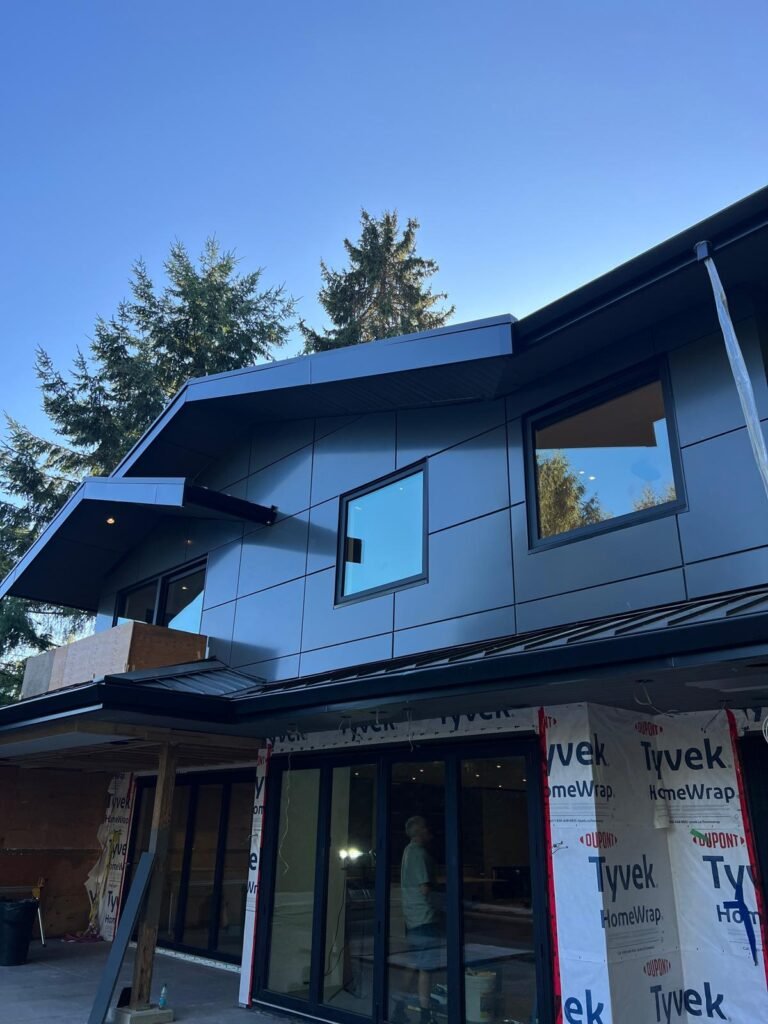
Getting a Tyvek air barrier right has less to do with applying the membrane itself and more to do with how it’s detailed at the points where most failures actually happen — seams, laps, corners, and anywhere the wall is penetrated by a window, vent, or pipe. A wrap that looks perfectly applied across a flat wall can still let water in behind the cladding if a single window opening is poorly detailed.
We treat the air barrier as one connected system with the flashing, window preparation, and rain screen assembly around it, rather than as an isolated step. Each transition point is sealed and integrated so the assembly works together, instead of relying on the membrane alone to carry the job.
There’s no shortage of information online about installing a weather barrier yourself, and on a flat, simple wall section it can look straightforward. What’s harder to see from a video is what happens at the details — the overlaps, the taped seams, and the integration around every window, door, and penetration. Get those wrong, and the air barrier can still look complete from the outside while doing very little of its actual job.
The bigger issue is timing. Once the cladding goes on, this layer isn’t visible again. A mistake made here usually doesn’t surface as a problem until years later, in the form of trapped moisture, rot, or mold that’s already done its damage by the time anyone notices. Many manufacturers also tie their product warranties to installation by a qualified contractor, which is worth knowing if a warranty claim ever becomes relevant down the line.
This is part of why we treat Tyvek installation as a professional scope of work rather than a simple add-on to a siding job — it’s one of the layers where getting it right the first time matters more than almost anywhere else in the build.
One advantage of a properly installed Tyvek air barrier is that it isn’t tied to a single type of cladding. It functions the same way structurally whether the finished wall is a panel system, a fiber cement product, or a more traditional siding profile — the air barrier sits underneath, doing its job before the visible layer goes on.
On most of our projects, the air barrier is installed alongside a rain screen assembly, which creates a drainage gap behind the cladding so that any moisture that does get through has somewhere to go instead of sitting against the wall. See more here.
The same level of attention goes into window and door openings, where flashing and sealing have to be coordinated with the air barrier rather than treated as a separate task. Learn more.
Tyvek air barrier work also comes up often as part of a larger exterior renovation rather than as a standalone request, particularly on recladding and envelope upgrade projects. If that’s the situation you’re in, our renovation team can help scope the full picture — learn more.
Before any membrane goes on, we check the sheathing for moisture damage, irregular surfaces, or anything that needs to be addressed first. Installing over a compromised substrate undermines the air barrier no matter how well the membrane itself is applied.
The Tyvek membrane is applied as a continuous layer across the wall, with seams and laps sealed so the barrier functions as one connected system rather than a patchwork of separate sheets.
Every window, door, and penetration is flashed and sealed in coordination with the membrane, then handed off to the rain screen and cladding work that follows. This is the stage where most real-world failures happen, so it gets the most attention.
10+
Years of experience
100+
Completed projects
100%
Licensed & insured
Free
Estimate — no obligation
Code-Compliant, Insured Installation
Every air barrier installation meets BC Building Code requirements, with our team fully insured on every job.
Always Integrated, Never Isolated
We don't treat the air barrier as a standalone step — it's detailed and coordinated with the rain screen assembly and window flashing on every project.
Free, Itemized Estimates
No vague quotes. A clear, itemized breakdown before any work begins.
Genuine Tyvek Membrane
We install genuine Tyvek weather-resistive barrier products, detailed to manufacturer specifications on every job.
Local Team
Based in West Vancouver and working across Metro Vancouver — we know the climate, the building codes, and what it takes to get this layer right the first time.
Clean Job Sites
We treat your property with care — thorough cleanup is part of every job, every time.
Not automatically. House wrap is a general term for the material itself, but it only functions as a true air barrier when it's installed as a continuous, sealed layer — taped at seams and properly integrated around windows and penetrations. A house wrap that's simply stapled up without sealing the details doesn't perform the same job, even if it's the same material.
No, not in the way that matters for building performance. Tyvek is designed to block the bulk movement of air through the wall assembly when installed correctly. What it does allow is water vapor to slowly pass through it, which is a different property and is actually part of why it works well in a wet climate like ours.
Yes, that's one of its main jobs. Tyvek resists bulk water intrusion, helping keep rain from reaching the wall sheathing behind your siding or cladding. It's typically installed alongside a rain screen system, which gives any moisture that does get through a way to drain out rather than sit against the wall.
A properly installed Tyvek air barrier should have very little air leakage. The seams and overlaps are taped and sealed, and transitions around windows, doors, and other penetrations are detailed specifically to prevent air movement at those points. Where air barriers tend to fail in practice is at these connection points, not across the flat wall area itself, which is why detailing matters as much as the membrane.
We typically install Tyvek air barriers as part of a larger scope, such as new construction, recladding, a full siding installation, or a building envelope upgrade. It's rarely requested as a completely isolated service on its own, since it needs to be coordinated with the rain screen, flashing, and cladding work happening around it. If you're planning an exterior project, this is usually one piece of that broader conversation rather than a separate one.
Yes. Recladding and envelope upgrade projects are actually a common time to install or replace this layer, since the wall is already opened up. It gives us the chance to correct any existing moisture issues and install a properly detailed air barrier before the new cladding goes on.
If a Tyvek air barrier is part of an upcoming project — new construction, recladding, or a broader exterior renovation — we’re happy to talk through what your building needs and where this layer fits into the bigger picture.
Request your free, no-obligation estimate and we’ll walk you through it.
Get a quote today
Hours
Why Silver Siding exterior
Fill out the form below