Modern buildings call for cladding that looks sharp today and still performs decades from now. AL13 is an aluminum panel and plank cladding system built around exactly that idea — a clean, architectural finish that holds its shape and color far longer than vinyl or painted wood, without the upkeep that comes with either.
What sets AL13 apart from most metal cladding is how it’s built. Instead of pre-fabricated panels shipped to spec, the system is cut to fit on site and secured with its own frame components, with a pressure-equalized rain screen built into the design rather than added on afterward. That matters in a climate like Metro Vancouver’s, where moisture management isn’t optional — it’s the difference between cladding that lasts and cladding that doesn’t.
Silver Siding installs both the AL13 Panel System and the AL13 Plank System, for residential homes, multi-family buildings, and commercial properties alike. Whichever profile fits your project, the goal is the same: a precise, weather-tight install that looks the way it’s supposed to for years, not just on installation day.
AL13 isn’t a single product — it’s a family of aluminum cladding systems built around two distinct profiles that share the same underlying frame components, which means they can be combined on one building for a seamless transition between styles. Both are cut to fit on site rather than pre-fabricated off-site, and both rely on a tab-over, snap-lock installation method rather than welding, which lets each panel expand and contract with temperature changes instead of buckling.
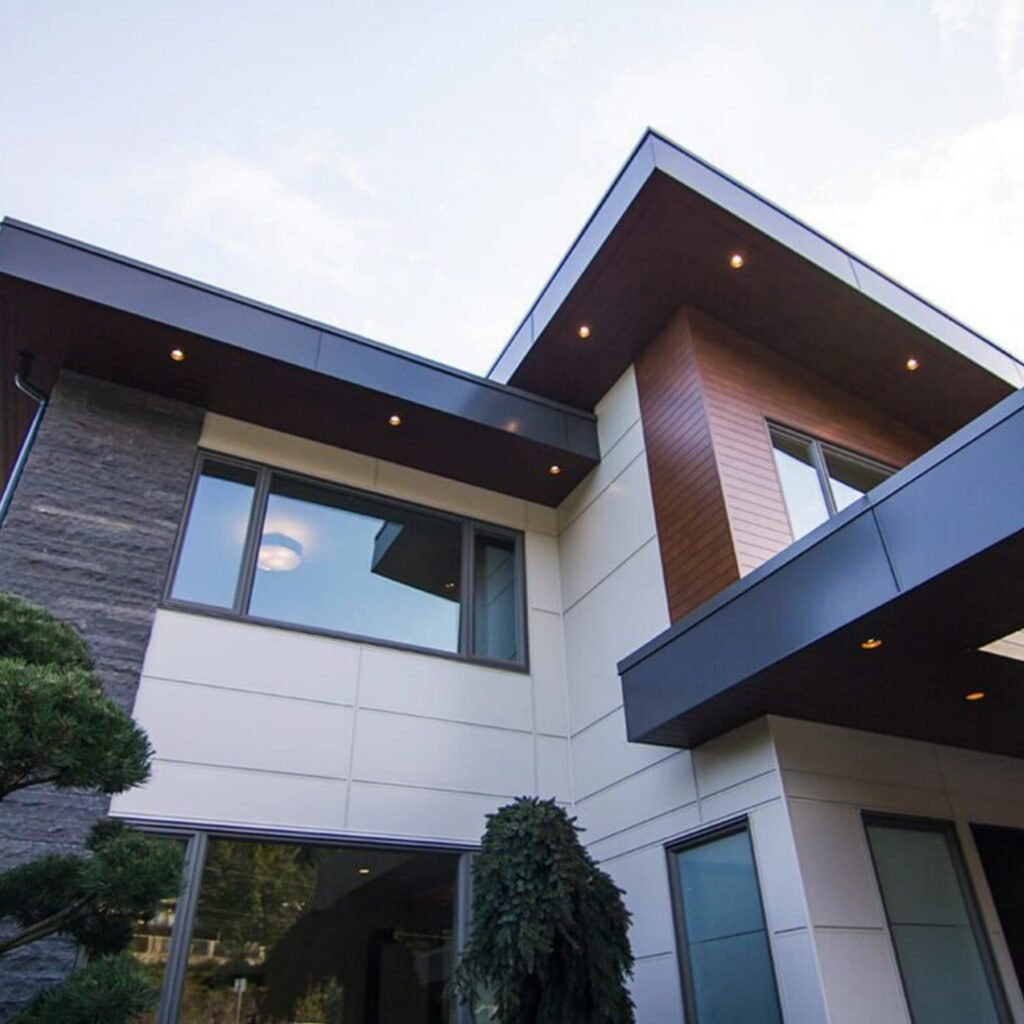
The AL13 Panel System is the flat-panel profile of the line — a clean, architectural look suited to modern residential, multi-family, and commercial facades. Panels are secured with frame components rather than adhesives, and individual panels can be removed and replaced without disturbing the surrounding installation, which is a real advantage if a panel is ever damaged. The spacers and extrusions behind the panels are designed to create a pressure-equalized rain screen, and the system is available with a standard polyethylene (PE) core or a fire-rated (FR) core for projects where local code calls for it.
The AL13 Plank System is the horizontal, wood-look profile — extruded aluminum finished to mimic the grain and shadow lines of real timber, without the maintenance that comes with actual wood siding. It’s available in a range of woodgrain finishes as well as solid colors, and because it shares framing components with the Panel System, the two can be mixed on the same building — for example, plank on the main facade with panel detailing around entries or feature walls.
Both AL13 systems are built around the same core performance ideas, which is a big part of why the line holds up well in a coastal climate like Metro Vancouver’s:
One question we hear often is how frequently aluminum siding needs to be replaced. Under normal conditions, it generally doesn’t follow a fixed replacement schedule the way wood or some composite materials do — most of the issues that come up are tied to physical impact, fastener wear over time, or long-term coastal salt exposure, and the individual-panel design makes those situations more straightforward to address than a full section replacement.
AL13’s clean lines and contemporary profile make it a natural fit for modern architecture, and we install it across residential, multi-family, and commercial projects alike — it isn’t a commercial-only product, and a single-family home is just as good a candidate as an apartment building or office.
Because the system depends on precise on-site cutting and a continuous rain screen assembly behind every panel, installation quality matters more than it might appear — a misaligned frame or an inconsistent gap can undermine the moisture management the system is designed around. This is one of the reasons we don’t recommend treating AL13 as a do-it-yourself project, even though the panels themselves are designed for efficient installation by a trained crew.
AL13’s performance characteristics translate differently depending on the building type, exposure, and density of each area we serve. The table below is meant as a general guide, not a fixed rule — the right fit always depends on the specific building and project.
| Service Area | Why AL13 May Be a Good Fit | Local Considerations |
|---|---|---|
| Vancouver | AL13’s clean, modern profile often suits the infill homes, laneway builds, and multi-family projects common across the city, where a contemporary exterior is frequently part of the design brief. | Denser lots can mean tighter clearances and more corner detailing, depending on the building’s footprint and setback requirements. |
| North Vancouver | Can be considered for both modern new builds and renovations on sloped or view-oriented properties, where a durable, low-maintenance facade is often a priority. | Properties higher on the slopes may see more wind-driven rain, which makes correct rain screen detailing especially important during installation. |
| West Vancouver | Often makes sense for higher-end modern and waterfront homes, where AL13’s architectural finish and color retention can support a more design-forward exterior. | Coastal and waterfront exposure generally calls for closer attention to fastener corrosion resistance and moisture management at terminations. |
| Burnaby | Can be a good fit for multi-family and commercial buildings, where the on-site cut-to-fit installation helps with larger or more complex elevations. | Taller or multi-unit buildings may have additional fire-rating requirements, depending on occupancy type and local code. |
| Richmond | Often suitable for commercial and multi-family construction, where low-maintenance cladding can help reduce long-term upkeep across larger building envelopes. | Flatter terrain and proximity to water can mean higher humidity exposure, depending on the site, which is a factor in rain screen detailing. |
AL13 sits in a crowded category of modern exterior claddings, and the right choice often comes down to the specific look, budget, and performance priorities of a project. Here’s how it compares to the other systems we install.
AL13 is, technically, a type of aluminum composite material — but the way it’s engineered sets it apart from a typical ACM panels Installation. Standard ACM systems are usually routed and returned or pre-fabricated to size off-site, while AL13 is cut to fit on the job and secured with snap-lock frame components, which also means a single damaged panel can be swapped without disturbing the rest of the wall. The visual result is similar; the installation approach and repairability are not.
Both are modern architectural panel systems with woodgrain and solid-color options, and both can hold their own as a primary facade material. The main difference tends to come down to profile and finish range rather than one being a clear upgrade over the other — a LUX panels Installation may suit a project looking for a particular finish palette, while AL13’s strength is the shared framing between its Panel and Plank systems on the same elevation.
AL13’s Plank System and Longboard siding Contractor services both deliver an extruded-aluminum, wood-look plank — if your priority is that warm, linear wood aesthetic without real wood maintenance, either is a reasonable starting point, and the better fit usually comes down to the specific finish and profile available for your project.
“Metal siding” covers a much broader range of corrugated, standing-seam, and board-and-batten steel and aluminum profiles. A general Metal Siding Installation is the better fit for a more industrial or farmhouse-modern look; AL13 is a specific architectural system built around its own panel and plank profiles.
This is one of the more common comparisons we get. Vinyl is the lower-cost option up front, but it’s more prone to fading, warping, and cracking under direct sun and temperature swings over time. AL13’s aluminum face holds its shape and color longer, which is the main trade-off buyers are weighing when they ask about a Vinyl Siding Installation versus AL13.
Before any AL13 component goes up, we check the existing wall assembly — confirming the substrate is sound, checking for existing moisture damage, and identifying anything that needs attention before the frame components go on. This step matters more with a system like AL13 than with some claddings, since the rain screen depends on a clean, properly prepared surface underneath.
A Tyvek air barrier goes over the substrate first. AL13's own frame components and extrusions are then installed to create the system's pressure-equalized rain screen — this isn't a separate add-on step, it's built into how the system goes together. Getting this stage right is what determines whether moisture that gets behind the panels actually has somewhere to go.
Unlike pre-fabricated cladding, AL13 panels and planks are cut to fit on site and secured with the system's snap-lock frame components — no welding, no adhesives. Whether the project calls for the Panel System, the Plank System, or a mix of both on the same elevation, each piece is fitted, leveled, and finished at corners and transitions to keep the rain screen continuous and the final look clean.
10+
Years of experience
100+
Completed projects
100%
Licensed & insured
Free
Estimate — no obligation
Licensed & WorkSafeBC Compliant
Every AL13 installation meets BC Building Code requirements, with our crews fully insured on every job.
Rain Screen as Standard
Every AL13 installation includes a properly detailed, pressure-equalized rain screen — not an optional upgrade.
Free, Itemized Estimates
No vague ballpark numbers. You get a clear, itemized breakdown before a single panel goes up.
Genuine AL13 Panel & Plank Systems
Supplied and installed to AL13's own specifications — Panel System, Plank System, or both on the same elevation. No off-brand substitutions without your approval.
Local Team
West Vancouver-based, working throughout the North Shore and beyond. We know the slopes, the access points, and the permit process specific to this region.
Clean Job Sites
Every project wraps with a full site cleanup — no shortcuts, no mess left behind.
The Panel System is a flat, architectural profile suited to clean modern facades, while the Plank System is a horizontal, wood-look profile designed to mimic real timber. Both share the same underlying frame components, so they can be combined on the same building, and both include AL13's built-in pressure-equalized rain screen.
The aluminum facing itself is non-combustible. AL13 also offers a fire-rated (FR) core option for projects where local building code requires it, alongside a standard polyethylene (PE) core. We can confirm which core is right for your specific project and code requirements during your quote.
AL13 is built to resist warping, rotting, and cracking, and its finish is designed to hold its color far longer than vinyl or painted wood. Because real-world performance depends on installation quality, climate exposure, and maintenance, we're happy to go through expected performance in detail for your specific property during a quote, rather than quoting one generic number that may not apply to every project.
The factory finish is engineered to resist fading, peeling, and cracking under UV exposure better than standard paint or vinyl finishes. As with any exterior cladding, long-term finish performance also depends on correct installation and the specific finish chosen.
Yes — the system's built-in pressure-equalized rain screen is specifically designed to manage moisture in wet, coastal climates like Metro Vancouver's, and the aluminum face won't absorb water the way wood or some composite materials can.
Under normal conditions, AL13 doesn't follow a fixed replacement schedule. Most issues that come up are tied to impact damage, fastener wear over time, or long-term coastal exposure rather than the material breaking down on its own, and because panels and planks can be replaced individually, fixing a problem usually doesn't mean replacing an entire section.
AL13 is generally a premium option compared to vinyl siding, reflecting its aluminum construction, finish durability, and cut-to-fit installation process. The exact cost for your project depends on factors like the building's size and shape, the number of corners and transitions, whether you choose the Panel System, Plank System, or both, and the overall complexity of the elevation. We provide a detailed, itemized estimate after assessing your specific property.
We handle both — supply and full installation of AL13 Panel and Plank Systems, from the initial site assessment through final finishing and cleanup.
Whether you’re planning a new build with AL13’s Panel System, refreshing a tired exterior with the Plank System’s wood-look finish, or just want a straight answer about which system fits your project, we’re happy to talk it through. Feel free to browse some of our completed exterior projects first, then request a free, no-obligation quote and we’ll walk you through the right fit for your property.
Get a quote today
Hours
Why Silver Siding exterior
Fill out the form below