
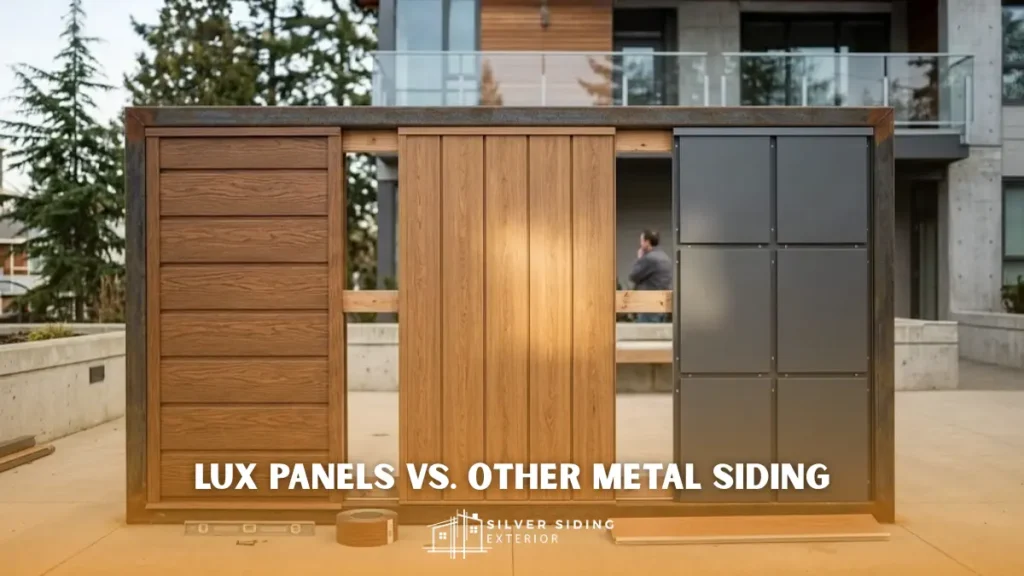
The short version: it comes down to the substrate
Strip away the marketing and these three products differ mainly in what they are made of, and everything else follows from that.
Everything below comes from Silver Siding Exterior’s own hands-on installation experience on real Metro Vancouver walls — how these systems behave once they are up, weathered and lived with — not from re-reading the manufacturers’ catalogues back to you.
| System | What it is | Relative cost |
|---|---|---|
| LUX | Roll-formed Galvalume steel plank | Most economical |
| Longboard | Extruded aluminum plank | Most premium |
| AL13 | Aluminum composite panel | Mid to high-end |
Where each one typically ends up:
- LUX — full walls, feature walls, soffits and board-and-batten looks.
- Longboard — feature walls, full walls, soffits and screens.
- AL13 — flat modern panel façades, multi-family and commercial buildings.
If you take nothing else away: LUX is a steel product, Longboard is an aluminum extrusion, and AL13 is a composite panel system. They are not three versions of the same thing. If you want to see how each behaves on a real wall rather than in a brochure, our project photo gallery is the fastest way to compare them side by side.
LUX vs Longboard: steel or aluminum?
This is the comparison almost everyone is really making, and it has been asked in almost exactly those words for years. On a Canadian building forum, one homeowner researching wood-look cladding put it plainly: he wanted to know whether anyone had experience with LUX Panel, because it “looks very similar to Longboard but steel.” That is the whole question, and the answer is: yes, and the substrate change has real consequences in both directions. You can read the original thread and the replies from people who actually own these products.
Where steel wins
- Hardness. Steel resists impact denting better than aluminum of comparable thickness — relevant for walls near driveways, ladders, sports nets and construction traffic.
- Price. Steel is the reason LUX lands well below Longboard on material cost. That gap is the single biggest driver of LUX’s popularity.
- Custom lengths. LUX is produced to order in lengths from roughly 4 ft to 24 ft, which cuts offcut waste on walls with awkward dimensions.
- Fire performance. LUX is a non-combustible steel product with a Class A fire rating and zero flame spread under CAN/ULC S102.
Where aluminum wins
- It cannot rust. Aluminum has no iron in it. Steel relies on its Galvalume coating and its finish; cut ends and deep scratches are its weak points, not the panel face.
- Rigidity per profile. Longboard is an extrusion, not a rolled sheet — several people who have handled both describe the difference as immediately obvious when you pick up a plank.
- Substrate warranty. Longboard carries a lifetime warranty on the aluminum substrate and a 15-year non-prorated warranty on the finish; LUX carries a 25-year finish warranty. Read those two sentences carefully — they cover different things, and comparing “25 years” to “15 years” without reading which component is covered is the most common mistake buyers make.
- Colour range. Longboard offers a considerably wider palette (20+ woodgrains, 60+ solid colours) than LUX, though LUX has narrowed that gap.
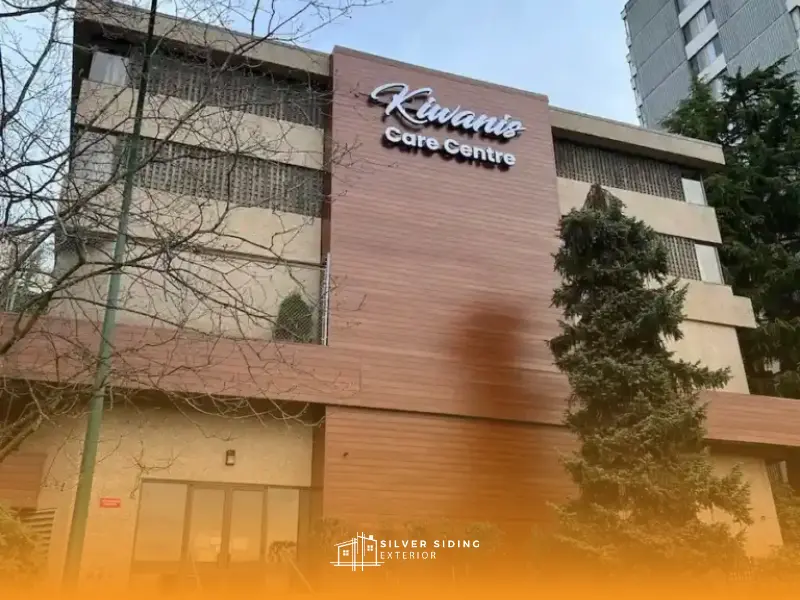
If the aluminum route is the one you are leaning toward, our Longboard siding page covers profiles and detailing in more depth. If the steel route makes more sense for your budget, that is what our lux siding installation page is for.
LUX vs AL13: a plank versus a panel system
This comparison confuses people because AL13 is often described as “aluminum siding,” which makes it sound like a Longboard competitor. It is closer to a different category.
AL13’s flagship product is an aluminum composite panel — two thin aluminum skins bonded to a rigid core. It is engineered as a pressure-equalized rainscreen system with built-in moisture management, and tested to AAMA 508.
It also has a plank line if you want the wood look, but the panel system is what it is known for.
What that means practically:
- AL13 gives you flat, large-format panel faces; LUX gives you a woodgrain plank. These are different aesthetics, not two price points for the same look.
- AL13 panels are cut to fit on site rather than fabricated off site, which removes the shop-drawing lead time that traditional composite panel systems carry.
- AL13 offers a fire-rated mineral core option alongside the standard polyethylene core — a genuine differentiator on multi-family and taller buildings where NFPA 285 and CAN/ULC S134 compliance is the deciding factor, not the look.
- AL13’s product warranty is typically stated at 20 years.
So the honest framing is not “LUX or AL13.” The real question is simpler: do you want a plank, or do you want a panel?
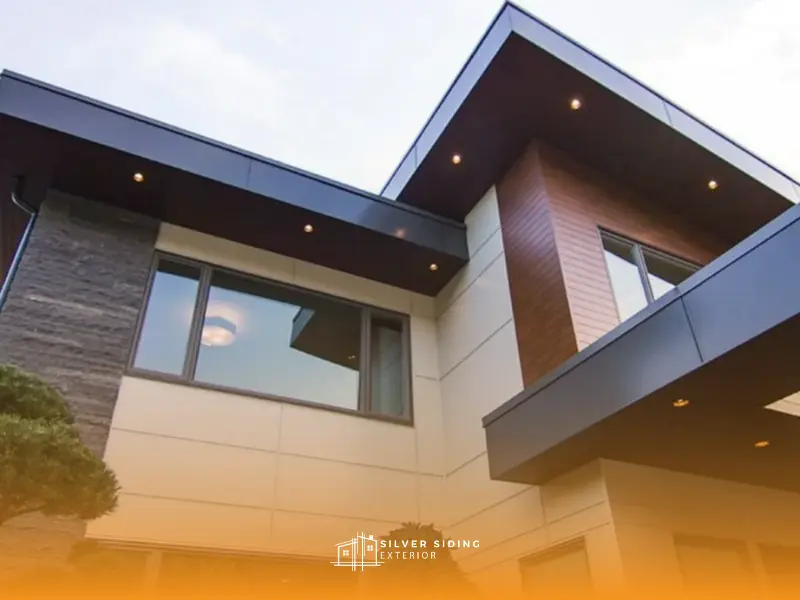
If it’s a panel, look at AL13 panels, and read up on how composite cladding is built up generally, because the same construction logic applies to every product in that family.
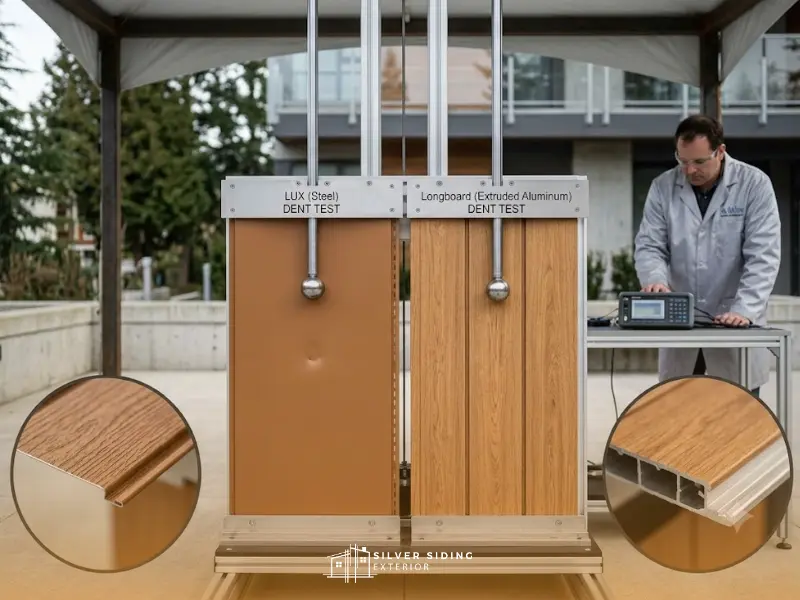
Will Hail Dent Metal Siding? (LUX vs Longboard)
This is a real question that real people ask, and it deserves a real answer instead of “our product is very durable.” In that same forum thread, one person looked at a Longboard installation video and predicted a decent hailstorm would wreck it — and an owner who actually had the product on his house pushed back, pointing out the walls are vertical and that horizontal hail hard enough to dent them would be an unusual event.
That exchange is more useful than any spec sheet, so here is the practical version:
- Vertical walls are not roofs. Impact energy arriving at a steep angle is a fraction of what a horizontal surface takes. Hail is a much bigger concern for metal roofing than for metal siding.
- In Metro Vancouver, hail is a marginal risk anyway. Our real impact hazards are ladders, scaffolding, wheelbarrows, patio furniture and construction traffic — all of which land at ground level, on the first metre or two of wall.
- That is where steel’s hardness genuinely pays for itself, and it is a fair argument for LUX at grade level even if you use something else higher up.
- Dents in any of these systems are repaired by replacing a plank or panel, not by filling. That is far easier when the product is still in production and made locally — a point in LUX’s favour.
Will the woodgrain fade?
One commenter in that thread made the sharpest observation of the whole discussion: the substrate will never degrade, but what about the woodgrain finish, which is the thing the sun beats on every single day? That is exactly the right thing to worry about, and it is the reason finish warranties, not substrate warranties, are the number that should influence your decision.
| Finish system | Stated finish warranty | |
|---|---|---|
| LUX | PVDF-type coating over Galvalume steel | 25 years |
| Longboard | Powder coat, AAMA 2604 rated | 15 years, non-prorated |
| AL13 | Prefinished aluminum skin | 20 years (product) |
A note on the Longboard number, because it looks bad in a table and is not: a representative from the manufacturer explained in that thread that the 15-year figure is tied to AAMA 2604 performance testing under South Florida natural-exposure conditions — a brutal UV and humidity benchmark that has very little to do with a Vancouver wall. A shorter warranty backed by a harsher test is not the same as a weaker finish. Ask what the number is measured against before you let it decide anything.
How do these hold up on the coast?
This is where our own experience diverges most from what the national marketing says, because the failure mode here is not sun — it is water, and it is salt.
Every one of these systems is fine on a wall that is detailed properly, and every one of them will disappoint you on a wall that is not. Specifically:
- None of these products is a waterproofing layer. Water gets behind cladding. It always has. What keeps the wall dry is the assembly behind it — which is why we build almost every metal cladding job over a rain screen system with a properly lapped Tyvek air barrier underneath.
Choosing between steel and aluminum is really a second-order question; the first is whether the wall behind the cladding is built to drain and dry at all. If you are still comparing base materials before you get to LUX versus Longboard versus AL13, our breakdown of how metal, vinyl and fibre cement each perform in a wet coastal climate is the right place to start.
- Steel near salt air is a legitimate question, and the honest answer is that LUX’s Galvalume coating has passed ASTM B117 salt-spray testing — which is why it is used on waterfront properties. But cut ends and deep gouges are where steel is vulnerable, so cut-edge treatment and clean flashing details matter more on a steel product than an aluminum one. This is a workmanship issue, not a product defect.
- Aluminum sidesteps that concern entirely, which is a real argument for Longboard or AL13 on the most exposed oceanfront elevations.
- Soffits are the most-forgotten detail. All three systems have soffit options, and a mismatched soffit is the fastest way to make an expensive wall look cheap — worth planning at the same time as the walls, alongside your soffit installation.
Exposure is not uniform across the region either. A waterfront elevation in West Vancouver, a shaded north-slope wall in North Vancouver, an inland strata in Burnaby and a flat, wind-driven site in Richmond are four genuinely different problems, and the right answer can legitimately be a different product on each.
What is the real cost gap?
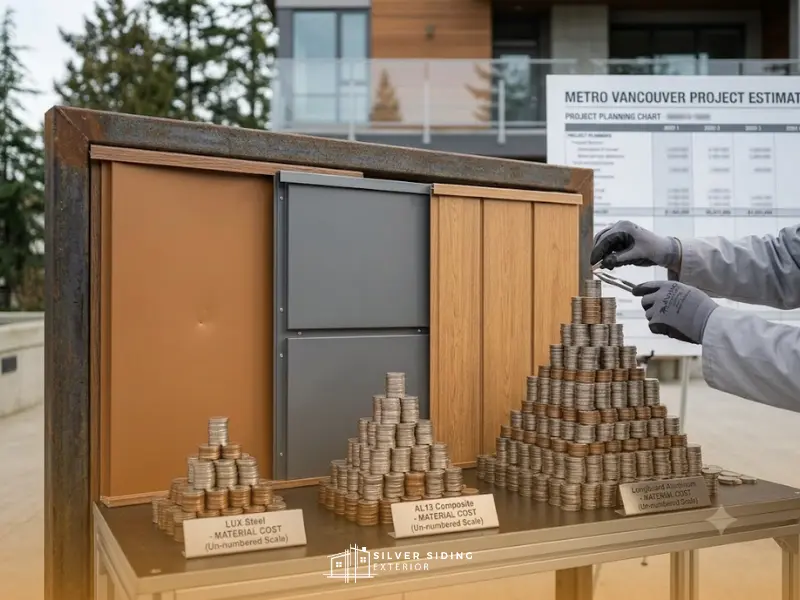
Nobody will publish reliable current numbers, so instead of quoting figures that would be out of date by the time you read them, here is the part that actually holds steady — the pecking order.
- LUX is the economical entry into wood-look metal. It sits clearly below Longboard, and that value is the entire commercial logic of the product — it is why it grew so fast.
- AL13 is the mid-tier. Depending on core type and panel layout, it can land closer to LUX or reach toward Longboard territory.
- Longboard is the premium, high-end option. You pay for the extrusion, the rigidity and the colour range, and on the right wall it earns it.
- All three are a significant step up from fibre cement, which is the comparison that actually shifts budgets. If your reaction to any of these is sticker shock, the honest recommendation is not a cheaper metal — it is a different material, or metal used only as a feature wall.
One more thing that surprises people: complexity costs more than the panel does. A simple two-storey rectangle in the premium product can come in under a heavily articulated façade in the economical one, because corners mean cuts and cuts mean labour. Using metal as a feature — an entry, a projecting volume, a soffit run — with a more cost-effective cladding elsewhere is not a compromise. It is what most well-designed houses in this region actually do.
Is metal siding really maintenance-free?
No. The most honest line we have ever read on a building forum was a commenter’s reminder that nothing is maintenance-free — there is only low-maintenance and high-maintenance. He was right, and it is worth reading that discussion in full.
What “low maintenance” actually means with LUX, Longboard or AL13:
- No painting, staining or refinishing. This is the genuine, enormous win over wood.
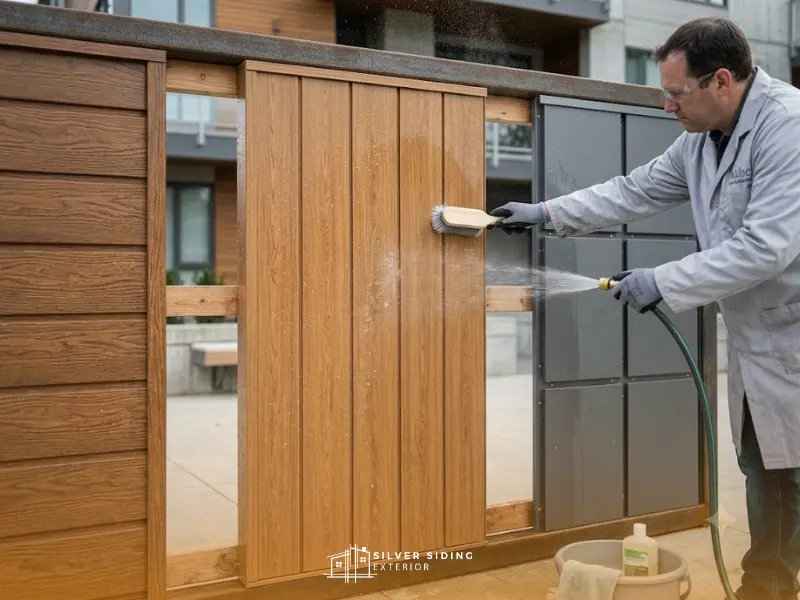
- An annual rinse. Coastal salt film and organic grime dull a finish over time. A garden hose handles it.
- Watch the sheltered, north-facing surfaces. Metal will not grow mould the way wood does, but surface algae can still settle on damp, shaded elevations.
- Keep drainage paths clear. Blocked rainscreen cavities and clogged gutters do more damage to a cladding assembly than any weather event.
- Touch up damage promptly on steel. A deep scratch on aluminum is cosmetic. A deep scratch on steel exposes the substrate.
The variable most people underestimate: installation
An installer working with Longboard on his own home described it as expensive but exceptionally well-engineered — a precision system, with 24-foot lengths that are awkward for one person, and his blunt advice was to choose your installer very carefully and make sure they are actually capable of that type of install. His first-hand account is here, and it matches our experience exactly.
This is the part of the decision nobody markets, so we will be direct about it:
- Long-format planks magnify framing error. A wall that is out of plane by a quarter inch will show it. Substrate correction happens before the first plank, or it does not happen at all.
- Flat panel systems are even less forgiving than planks. Large, flat, reflective faces reveal every high spot in the wall behind them.
- Trim and transitions are where jobs go wrong. Inside corners, window returns and soffit transitions consume a disproportionate share of the labour and are what separates a clean job from an obviously amateur one.
- The system is the product. These are engineered assemblies with their own clips, girts and trims. Substituting parts or improvising details voids more than the warranty — it compromises the wall.
A well-installed LUX wall will outperform a badly installed Longboard wall every time. If your budget forces a choice between the premium product and the experienced crew, take the crew.
So which one should you choose?
LUX is the right call when
- You want the wood-look plank aesthetic across a large area and the Longboard number does not fit the budget.
- The wall is exposed to physical impact — driveways, walkways, ground-level elevations.
- You value custom lengths and short domestic lead times over the widest possible colour palette.
- Non-combustible construction is a requirement.
Longboard is worth the premium when
- The area is small enough that the price difference is not decisive — a feature wall, an entry, a soffit run.
- The elevation is oceanfront and you simply do not want a ferrous substrate in the assembly.
- You need a specific colour or grain that only Longboard’s range offers.
- The architect has specified the extrusion’s crispness and no substitute will read the same.
AL13 is the right call when
- The design wants flat, large-format modern panels — not a plank.
- The project is multi-family or commercial and a fire-rated core is required.
- You want a tested pressure-equalized rainscreen built into the cladding system itself.
If none of those descriptions fit, the answer may simply be that metal is not the right material for your project — and there is no shame in that. Metal is one option among several, and a well-detailed fibre cement wall will outlast a poorly chosen metal one.
At a glance: which system for which job?
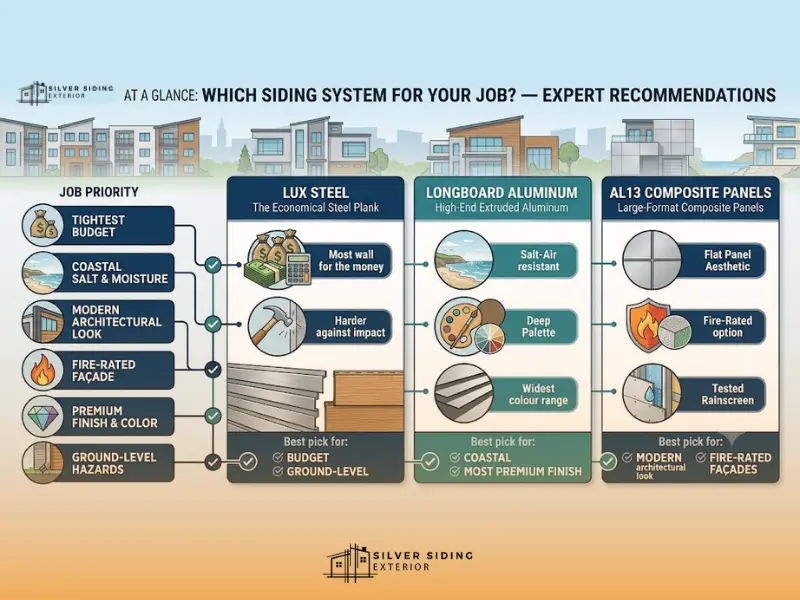
If you have read this far and want the whole thing on one line, here it is.
| If your priority is… | Best pick | Why |
|---|---|---|
| The tightest budget for a wood-look wall | LUX | The economical steel plank; most wall for the money, and harder against impact |
| Coastal salt and moisture exposure | Longboard | Aluminum can’t rust, so cut ends and salt air are non-issues on oceanfront elevations |
| A flat, modern architectural look | AL13 | Large-format composite panels — a panel aesthetic, not a plank |
| A fire-rated multi-family or commercial façade | AL13 | Fire-rated mineral core option with a built-in tested rainscreen |
| The most premium finish and widest colour range | Longboard | High-end extrusion, crisp shadow lines, the deepest palette |
| Ground-level walls near impact hazards | LUX | Steel’s hardness earns its keep at driveway and walkway height |
Where to go from here
The fastest way to break a tie is to stop reading and start touching. Order samples of all three, take them outside, look at them in Vancouver’s grey overcast light — not showroom light — and hold them against your roof, window frames and stone. Woodgrain finishes in particular look completely different at 3 metres than they do at 30 centimetres.
Better still: send us photos of the actual wall you’re deciding on. A few phone shots of the elevation — ideally with the roofline, windows and any stone or brick in frame — tell us more than any spec sheet. From those we can tell you which of the three suits that specific wall, flag the exposure and detailing issues you can’t see in a brochure, and give you a straight recommendation for your project rather than a generic one.
You can browse our full range of exterior work first, then reach out with your photos whenever you’re ready. We’d rather talk you into the right product than the expensive one — and we’ll tell you if metal isn’t it.
