
Modern Home Siding Trends in 2026: What Actually Changed
Choosing siding in 2026 isn’t just about picking a color you like. It’s one of the few decisions that affects your home’s durability, maintenance costs and long-term value all at once.
Most homeowners focus on how siding looks. Here’s the part many contractors don’t fully explain:
The wrong siding choice in a wet coastal climate can quietly cost you thousands over time — through moisture damage, maintenance, and early replacement.
The bigger shift this year isn’t a single new material. It’s that the industry moved away from cool greys and uniform facades toward warmer colors, stronger texture, and exteriors built as complete systems rather than a surface layer. That shift is what the ten siding design ideas below have in common.
In this guide we’ll break down:
- what’s actually trending in 2026, and what quietly went out of style
- which materials genuinely perform, not just photograph well
- what real homeowners regret after installation
- and which siding choices hold up in a high-rainfall coastal climate
You’ll also find practical pros and cons, comparison tables, and the small details most people only learn after they’ve already spent the money.
The 10 Siding Design Ideas Defining 2026
If you only read one section, read this one. Here’s the short version of every trend covered below, and how each one behaves in a rainy climate.
| # | Siding Trend | What It Looks Like | Best For | Wet-Climate Verdict |
|---|---|---|---|---|
| 1 | Warm Earthy Neutrals & Greens | Beige, almond, taupe, sage, olive | Homes that need to age well, not date fast | ✅ Excellent — hides rain grime |
| 2 | High-Contrast Color Combinations | Dark siding, light trim, wood accents | Modern and new-build architecture | ✅ Good with the right finish |
| 3 | Bold & Dark Siding Colors | Charcoal, black, navy, deep green | Contemporary and custom homes | ⚠️ Needs fade-resistant, matte finish |
| 4 | Wide & Thick Panels | Large-format boards, fewer seams | Clean, minimal facades | ✅ Strong — joint detailing is critical |
| 5 | Minimalist Flat Panels | Smooth surfaces, hidden fasteners | Modern architecture with strong lines | ⚠️ Unforgiving — needs precise install |
| 6 | Vertical & Board-and-Batten | Up-and-down lines, battens, tall proportions | Farmhouse, transitional and modern homes | ✅ Good — sheds water well if detailed right |
| 7 | Wood-Look Without Real Wood | Woodgrain aluminum, steel, fibre cement | Anyone who wants cedar without cedar upkeep | ✅ Excellent — the standout wet-climate option |
| 8 | Mixed Materials | Two or three materials on one facade | Custom builds and full renovations | ⚠️ Transitions decide the outcome |
| 9 | Accent-Driven Design | Premium material used only in key areas | Budget-conscious upgrades | ✅ Excellent — limits exposure of soft materials |
| 10 | Sustainable & Low-Maintenance | Long-life, recyclable, system-based assemblies | Long-term owners and new builds | ✅ Excellent — durability is sustainability here |
Trend 1 – Warm Earthy Neutrals and Green Tones
What are warm earthy neutrals?
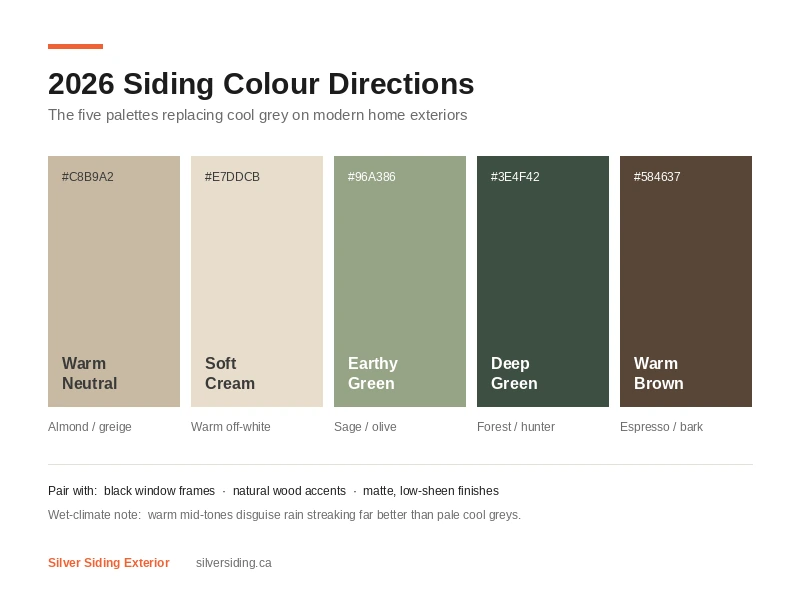
The defining color story of 2026 is the retreat of cool grey. After roughly a decade of charcoal-to-silver palettes, exteriors are moving toward warm, grounded neutrals — beige, almond, greige, taupe, soft cream — and toward earthy greens like sage, olive and deep forest.
These are not pastel or washed-out colors. They’re saturated, natural tones that read as calm rather than cold, and they sit comfortably against landscaping, stone and natural wood.
Why warm neutrals and greens are trending in 2026
Part of this is simple fatigue. Cool grey exteriors dominated for so long that they stopped signalling “current” and started signalling “built around 2018.” Warm neutrals read as newer for exactly that reason.
The paint industry has reinforced the shift. Sherwin-Williams and HGTV Home selected the grounded neutral Universal Khaki for 2026, while Dutch Boy named the soft, creamy beige Melodious Ivory — both firmly in the warm camp. Exterior color follows interior color with a short lag, and siding manufacturers have expanded their warm and green ranges accordingly.
Green in particular has become what one designer described as the new neutral. It anchors a home to its surroundings instead of contrasting with them, which is why it performs so well on properties with mature trees or heavy landscaping.
Pros and cons of warm neutral and green siding
+ Pros:
- Ages far better than cool grey, which dates quickly
- Hides rain streaking and surface dirt more effectively than white or pale grey
- Pairs easily with wood, stone, brick and black window frames
- Broad resale appeal — reads as considered rather than trend-chasing
– Cons:
- Warm tones can look muddy under overcast light if the undertone is wrong
- Greens are polarising at resale if pushed too saturated
- Fewer stock options than grey in some product lines
- Undertones shift noticeably between morning and evening light
2026 siding color directions and what they pair with
| Color Family | Example Tones | Pairs Best With | Wet-Climate Note |
|---|---|---|---|
| Warm neutral | Almond, greige, taupe | Black window frames, cedar accents | ✅ Excellent — most forgiving on dirt |
| Soft cream / off-white | Ivory, warm white | Stone base, dark trim | ⚠️ Shows streaking on smooth finishes |
| Earthy green | Sage, olive | Natural wood, warm stone | ✅ Excellent — blends with landscape |
| Deep green | Forest, hunter | White or cream trim, black hardware | ✅ Good with fade-resistant finish |
| Warm brown | Espresso, bark | Light stone, metal accents | ✅ Excellent |
Color is only half the decision. The finish carries the other half — a warm neutral on a low-quality substrate will chalk and fade long before the color goes out of style, which is why factory-applied finishes on fibre cement and metal siding have become the default for these palettes.
Common mistakes with warm neutral exteriors
- Selecting a warm neutral from a chip indoors, where its undertone reads completely differently than under overcast daylight
- Mixing a warm siding color with cool-toned trim or roofing, which makes both look wrong
- Assuming “neutral” means “safe” and skipping the sample step entirely
- Choosing a saturated green across an entire facade rather than testing it as a primary with restrained accents
Pro tip
Order large physical samples and mount them on the actual wall — north face and south face both — then look at them on a grey, overcast day, not a sunny one. In a coastal climate, overcast is the light your home will live in most of the year, and warm neutrals shift more under that light than any other color family.
Local Insight: Warm Neutrals in Metro Vancouver
Across Metro Vancouver — West Vancouver, North Vancouver, Vancouver, Burnaby and Richmond — this palette has a practical advantage beyond style. Warm neutrals and mid-tone greens disguise the fine grey film that constant rain deposits on exterior surfaces, while pale cool greys and bright whites show it within weeks of a wash.
Greens also work unusually well here because so many properties back onto mature evergreens. A sage or olive facade reads as intentional against that backdrop in a way it wouldn’t in a drier, more open landscape.
Trend 2 – High-Contrast Siding Color Combinations
What is high-contrast siding design?
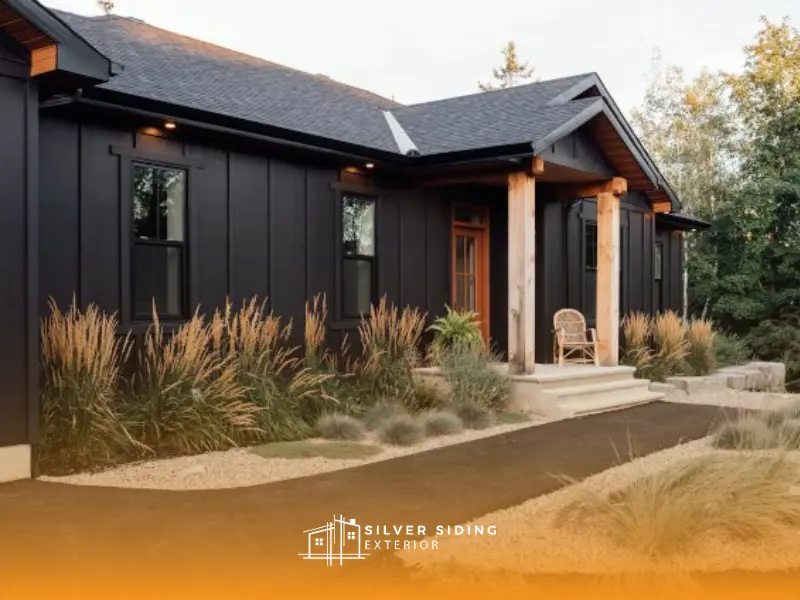
High-contrast design pairs dark siding with lighter trims or natural wood accents — charcoal or deep grey panels against warm cedar or crisp white detailing.
It remains one of the most reliable ways to make a simple structure look designed, which is why it has outlasted most of the trends it launched alongside.
Why high-contrast combinations keep trending
This comes from modern architectural styles built around clean lines and visual depth. Contrast highlights shapes, edges and structural elements, making even a simple massing look more premium.
It was also a reaction to years of flat, all-grey exteriors that started to feel repetitive. What’s changed in 2026 is the palette underneath it: the same contrast principle is now being applied with warm neutrals and greens rather than only charcoal and white.
Pros and cons of high-contrast siding
+ Pros:
- Creates a high-end, modern look with no structural change
- Adds depth and visual interest to plain elevations
- Highlights architectural features like entries and rooflines
– Cons:
- Dark colors may fade faster with UV exposure
- Requires careful color coordination to avoid looking arbitrary
- Can show dust or streaks more easily in rainy areas
Best color combinations for modern siding in 2026
| Main Siding Color | Accent Color | Resulting Style | Wet-Climate Suitability |
|---|---|---|---|
| Charcoal Black | Natural Cedar | Modern Luxury | ✅ Excellent |
| Warm Greige | Espresso Brown | Warm Modern | ✅ Excellent |
| Deep Green | Cream Trim | Grounded Contemporary | ✅ Good |
| Navy Blue | Light Wood | Contemporary | ✅ Good |
| Black | Aluminum | Industrial | ⚠️ Moderate |
| Warm Beige | Dark Brown | Soft Modern | ✅ Excellent |
This approach works especially well for modern and luxury homes, particularly new builds with clean architectural lines, and for homeowners who want an exterior that feels bold and refined without being complicated.
Dark siding paired with natural wood accents remains the single most popular combination, especially when the dark field is a durable factory-finished material like fibre cement or James Hardie siding.
Real homeowner insight on dark siding
In real-world discussions, some homeowners report unexpected issues with darker siding:
“Two houses in my neighborhood have darker vinyl… one has had panels replaced multiple times, and the other shows visible waviness.”
This highlights a common concern with dark exteriors — heat absorption can cause material movement, particularly when the product or installation isn’t up to it.
Common mistakes with high-contrast design
- Overusing contrast without a clear architectural hierarchy, producing a cluttered or disjointed result
- Selecting combinations based only on trends rather than the home’s structure, orientation and light
- Underestimating the long-term impact of dark siding, including fading, heat absorption and visible wear in wet climates
Local Insight: High-Contrast Exteriors in Metro Vancouver
In a climate where rainfall is a constant rather than a season, the material carrying the dark color matters far more than the color itself.
- Dark surfaces develop visible water streaking faster in high-rainfall conditions
- Textured or matte finishes hide marks noticeably better than smooth, glossy panels
Trend 3 – Bold and Dark Siding Colors
What are bold and dark siding colors?
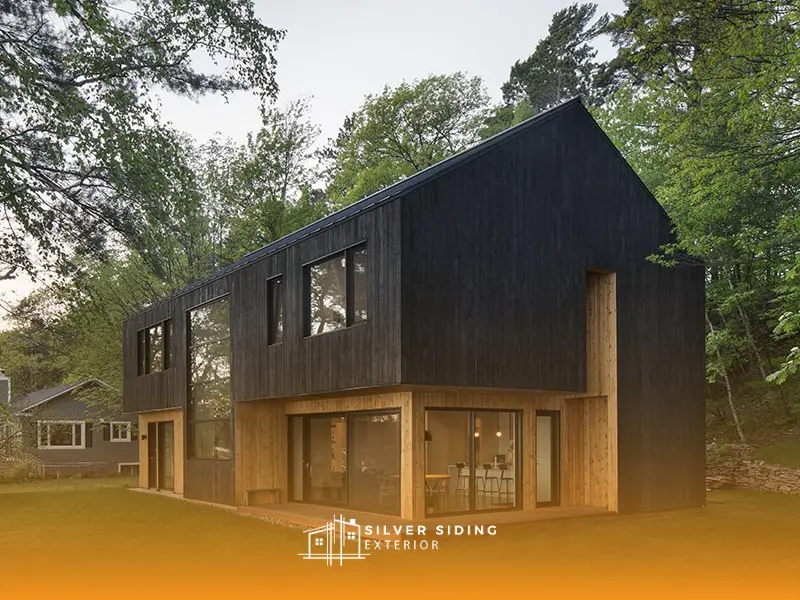
Bold and dark siding colors use deep, rich tones — charcoal, black, deep grey, navy, dark green — to create a strong visual impact rather than blending in.
Instead of light neutrals or conventional colors, this approach leans on dramatic finishes, usually balanced by lighter trims, natural wood accents or metal detailing. The result is a modern, confident exterior that feels architectural rather than conventional.
Why bold and dark colors are still trending
Dark exteriors give a home an immediately more modern and high-end presence, and they highlight architectural detail in a way lighter colors can’t. Even simple structures read as more intentional.
What has changed in 2026 is where dark tones are applied. Rather than wrapping an entire house in black, homeowners increasingly use deep colors on a feature elevation, an upper level or an entry volume — with a warmer neutral carrying the rest of the facade.
Material technology has also caught up. Fade resistance and heat performance in dark factory finishes are dramatically better than they were even five years ago, which has removed most of the practical objections to going dark.
Pros and cons of dark siding colors
+ Pros:
- Creates a strong, modern, high-end visual impact
- Highlights architectural features and clean lines
- Pairs naturally with wood and metal
- Distinguishes a home from conventional light-colored neighbours
– Cons:
- Shows dust, streaks and water marks more readily
- Higher heat absorption than lighter colors
- Fading occurs over time if the finish quality is low
- Demands careful coordination to avoid an unbalanced facade
Dark vs light siding colors compared
| Feature | Light Siding Colors | Dark Siding Colors |
|---|---|---|
| Visual Impact | Subtle / Traditional | Bold / Modern |
| Heat Absorption | Lower | Higher |
| Maintenance Visibility | Less noticeable dirt | Dirt and streaks more visible |
| Design Flexibility | Easier to match | Requires careful pairing |
| Fading Risk | Lower | Higher with low-quality finish |
| Overall Feel | Classic / Neutral | Dramatic / High-end |
You can read what homeowners think about dark-colored siding in this discussion.
Common mistakes with dark siding
- Choosing a dark color without considering maintenance, leading to visible dirt and streaking
- Using low-quality finishes that fade unevenly under UV exposure
- Applying dark tones across the entire exterior without contrast, making the home feel heavy and flat
- Ignoring how local light affects color perception, so the finished house reads far darker than expected
- Failing to balance dark siding with trim, window frames or accents
Pro tips for dark exteriors
- Use contrast deliberately. Pair dark siding with lighter trims, wood accents or metal details to keep the composition balanced.
- Insist on UV-resistant factory finishes. Not all dark colors behave the same; premium finishes hold depth far longer.
- Test in natural light. Dark shades shift dramatically with conditions — always check samples outdoors before committing.
- Choose matte or low-sheen. These finishes conceal imperfections, dust and streaks better than gloss.
- Go dark strategically. Feature areas deliver most of the effect with a fraction of the maintenance.
Local Insight: Dark Siding Under Overcast Skies
Dark siding reads beautifully against Metro Vancouver’s treeline and grey light — but the same conditions expose it. Frequent rain leaves water streaks and surface dirt more visible on dark tones, especially on smooth finishes, and that becomes an ongoing appearance question rather than a one-time design decision.
With the right substrate and a fade-resistant, low-sheen finish, dark exteriors hold up well here and stay striking even on overcast days.
Trend 4 – Wide and Thick Siding Panels
What are wide and thick siding panels?
Siding continues to move away from narrow, repetitive profiles toward wider and thicker panels that produce a cleaner, more architectural surface. Fewer, larger boards reduce visual clutter and emphasise strong horizontal or vertical lines.
Why wide panels are trending
Modern architecture prioritises simplicity and structure over decorative detail. Wider panels create fewer seams, which reads as more seamless and more expensive.
There’s a practical dimension too — thicker panels are generally more durable, more impact-resistant and better suited to long-term performance than thin profiles.
Pros and cons of wide and thick panels
+ Pros:
- Cleaner, more modern aesthetic
- Fewer joints and less visual noise
- Typically more durable and impact-resistant
– Cons:
- Higher upfront cost than standard siding
- Requires skilled installation for proper alignment
- Mistakes are far more visible at larger panel sizes
Standard narrow siding vs wide panels
| Feature | Standard Narrow Siding | Wide / Thick Panels |
|---|---|---|
| Visual Style | Traditional | Modern / Minimal |
| Number of Seams | High | Low |
| Installation Difficulty | Moderate | High |
| Durability | Moderate | High |
| Maintenance Visibility | Less noticeable | More noticeable |
| Relative Cost | $ – $$ | $$ – $$$ |
Wide and thick panels suit modern homes and new builds where clean lines are already part of the design — particularly for homeowners who want a bold but minimal exterior that feels structured rather than decorative.
Real homeowner insight on wide panels
“If you put the trim over the panels… you will have a gap and trying to fill it with caulk will look terrible and be a maintenance nightmare.”
Common mistakes with wide panel siding
- Choosing wide panels without adjusting the overall design, which can make a house look oversized or unbalanced
- Hiring installers with no large-format siding experience
- Ignoring spacing and alignment, which becomes obvious at this scale
Pro tip
If you’re going wide, confirm your contractor is using a proper spacing system and a planned panel layout. Small alignment errors that disappear on narrow siding are unmissable on large-format panels.
Wide panels are almost always installed as part of a complete exterior assembly, including a rain screen system and an air barrier layer, which manage moisture and drive long-term performance. Which panel material you choose changes how that assembly behaves, and the differences between metal, vinyl and fibre cement in wet conditions are larger than most product brochures suggest.
You can always contact us for a quote; click here to get a free estimate.
Local Insight: Wide Panels and Wet-Weather Joints
In Metro Vancouver’s climate, wide and thick panels perform very well — particularly in fibre cement — but the joints decide the outcome. Panel-to-panel detailing is where moisture either drains away or gets trapped, and on large-format panels there are fewer joints, but each one carries far more consequence.
Trend 5 – Minimalist Flat Panel Siding Designs
What is minimalist flat panel siding?
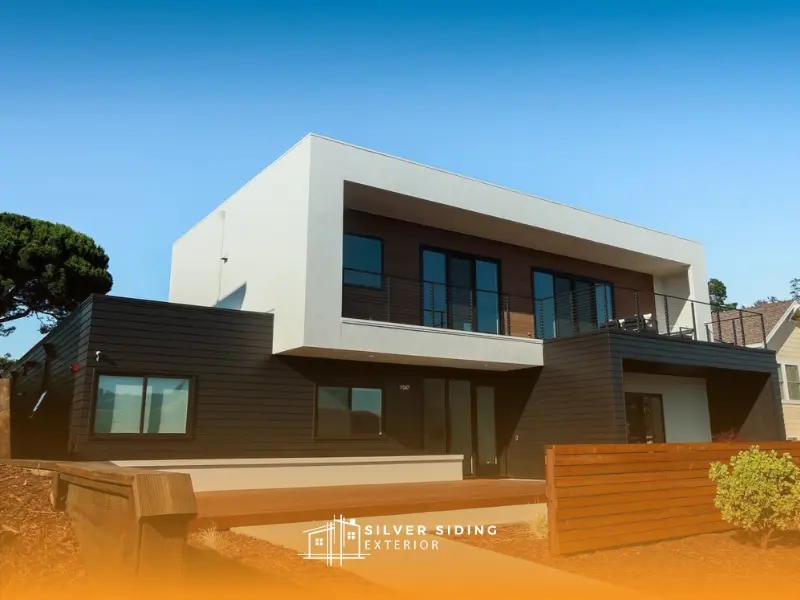
Minimalist flat panel siding uses clean, smooth surfaces with little or no visible texture. Instead of traditional lap siding or decorative profiles, it relies on large flat panels to create a sleek modern exterior.
The goal is fewer lines, fewer joints and a more refined architectural result — usually achieved with hidden fasteners and deliberately subtle seams.
Why minimalist flat panels are trending
Homeowners have moved toward cleaner exterior styles that feel timeless rather than decorative. After years of busy texture and layered detail, many now prefer surfaces that look calm, intentional and architecturally sharp. Flat panels deliver that by reducing visual noise and letting the building’s form carry the design.
There’s a practical appeal too: fewer joints and simpler profiles make the exterior easier to clean and maintain, especially in durable materials like fibre cement or metal panels.
Pros and cons of minimalist flat panel siding
+ Pros:
- Creates a clean, modern, high-end appearance
- Reduces visual clutter and emphasises the architecture
- Works across fibre cement, metal and ACM panel systems
- Smoother surfaces are easier to wash down
– Cons:
- Requires very precise installation; imperfections are highly visible
- Can read as cold or plain if not balanced with other elements
- Larger panels increase material and labour costs
- Repairs are more noticeable than on traditional siding
Minimalist flat panels vs traditional siding styles
| Feature | Traditional Siding (Lap / Textured) | Minimalist Flat Panels |
|---|---|---|
| Visual Style | Detailed / Textured | Clean / Smooth / Minimal |
| Number of Joints | High | Low |
| Design Focus | Material pattern | Architectural form |
| Installation Precision | Moderate | Very high |
| Maintenance Visibility | Imperfections less noticeable | Imperfections more noticeable |
| Overall Feel | Classic / Traditional | Modern / High-end |
Real homeowner insight on flat panel siding
Homeowners who have worked with flat panel systems consistently point out that simplicity in design doesn’t mean simplicity in execution:
“Panel siding can be a challenge to install properly… carefully work out the detailing… don’t just rely on your contractor.”
Common mistakes with flat panel siding
- Treating it as a “simple” choice when it demands more planning and precision than traditional siding
- Ignoring panel alignment and layout, producing uneven lines that are immediately obvious
- Using low-grade materials that won’t hold a smooth, clean finish over time
- Skipping detailing at joints, edges and corners, resulting in visible gaps and inconsistent seams
- Failing to balance the design with wood accents or window framing, leaving the exterior flat and sterile
Pro tips for minimalist flat panel siding
- Plan a panel grid before installation. A grid that aligns with windows, doors and edges makes the whole exterior feel deliberate rather than random.
- Choose the right finish. Matte and low-sheen surfaces hide imperfections; gloss amplifies even minor alignment issues.
- Don’t skip shadow gaps and reveals. Consistent gaps between panels add depth and make the design read as architectural.
- Balance simplicity with contrast. Dark window frames or restrained wood accents prevent a sterile result.
Flat, modern panel looks are usually achieved with one of the engineered metal systems, and the differences between them matter more than they first appear. If this trend is on your shortlist, it’s worth seeing LUX, Longboard and AL13 compared side by side before committing to a particular panel or plank profile.
If you’re aiming for a refined, minimalist exterior, our team can help bring that vision to life with precision and attention to detail. Visit our contact page to start your project.
Local Insight: Why Flat Panels Demand More Here
Minimalist flat panel systems rely on tight alignment and clean lines, which means moisture problems in Metro Vancouver show up visually long before they show up structurally — panel movement, staining, or uneven weathering across a facade that was supposed to read as one clean plane.
Ventilation gaps and drainage layers aren’t optional details on this style in a high-rainfall region. They’re the reason the look survives its second winter.
Trend 6 – Vertical Siding and Board-and-Batten
What is vertical siding design?
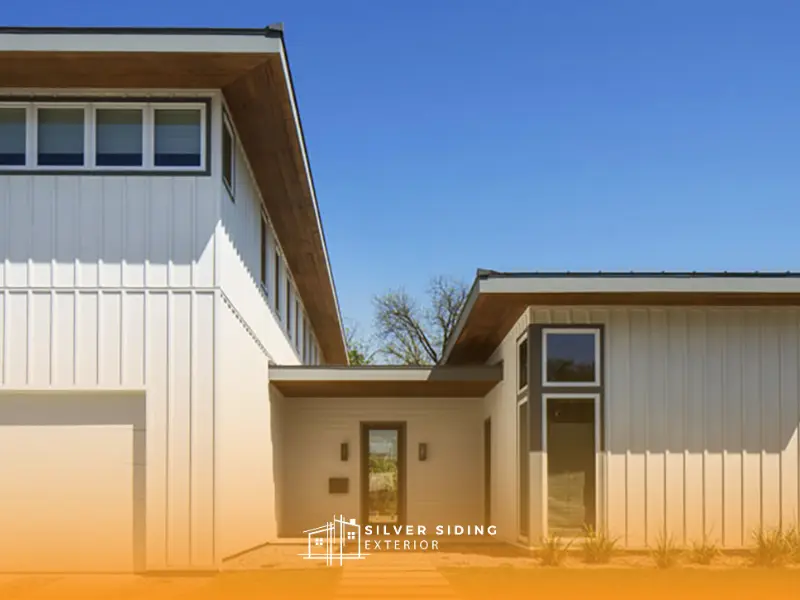
Vertical siding runs panels or boards up and down instead of horizontally. It covers three distinct looks: traditional board-and-batten, flat vertical panels, and modern concealed-fastener vertical systems.
Board-and-batten in particular has become one of the defining profiles of the last few years — and, contrary to what a lot of homeowners assume, it hasn’t gone out of style. What changed is how it’s used. Full board-and-batten facades have largely given way to board-and-batten as a defining accent: a gable, an entry volume, an upper level, paired with lap siding or stone elsewhere.
Vertical lines draw the eye upward, which makes a house appear taller and more architectural even when the structure itself is straightforward.
Why vertical siding and board-and-batten are trending
Vertical siding is one of the cheapest ways to make a home look substantially more modern without touching the structure. The proportional effect is real — vertical lines add perceived height, which is particularly useful on smaller or standard-height houses that need more presence.
It’s also become central to contemporary design, where mixing orientations — vertical on one section, horizontal on another — adds subtle contrast without making the exterior busy.
From a practical standpoint, vertical systems work well with modern materials like fibre cement panels and metal siding, both of which are widely used in today’s exterior designs.
Pros and cons of vertical siding
+ Pros:
- Makes homes appear taller and more visually striking
- Adds a modern architectural feel without structural change
- Ideal for highlighting entrances and upper levels
- Combines well with horizontal siding for a more dynamic facade
– Cons:
- More complex to install than horizontal siding
- Requires precise alignment; errors are more noticeable
- May need additional framing or support depending on the system
- Not every material performs well in a vertical application
Vertical vs horizontal siding compared
| Feature | Horizontal Siding | Vertical Siding |
|---|---|---|
| Visual Effect | Wider, more traditional | Taller, more modern |
| Design Style | Classic / Conventional | Modern / Architectural |
| Direction Impact | Expands width visually | Emphasises height |
| Installation Complexity | Standard | More complex |
| Alignment Sensitivity | Moderate | High |
| Best Use Case | Full exterior coverage | Accents or full modern design |
Vertical siding suits homeowners who want a home to feel taller and more refined without altering the structure. It’s a strong choice for modern and transitional homes, particularly when highlighting entryways, upper floors or narrow facades — and in most 2026 projects it’s used as an accent rather than across the entire exterior.
It’s also one of the most effective renovation moves available. Switching a tired horizontal facade to vertical lines updates a home’s read almost immediately.
Real homeowner insight on vertical siding
In homeowner discussions, moisture management is the concern that comes up most:
“We really like the smooth look of vertical siding… but someone warned us that water can get behind it easily, so we’re not sure if it’s the right choice.”
The concern is legitimate. Vertical siding can absolutely create a clean, modern result — but it needs correct detailing and moisture control to perform over time. Most of that control comes from the drained cavity behind the boards; our guide to what a rainscreen wall is explains how water that gets behind siding drains out instead of soaking in.
Common mistakes with vertical siding
- Installing without proper moisture management, increasing the risk of water penetration behind the panels
- Treating it like horizontal siding, when vertical systems require different detailing and support
- Ignoring top-to-bottom alignment, producing lines that look uneven
- Applying vertical siding to every surface, which becomes repetitive rather than intentional
- Selecting materials that aren’t rated for vertical installation
Pro tips for vertical siding and board-and-batten
- Start with moisture management, not layout. Vertical siding sheds water differently, so drainage, ventilation gaps and layering must be planned from the beginning.
- Use it strategically. It usually looks best highlighting specific sections rather than covering the whole exterior.
- Align panels with architectural elements. Vertical lines that meet windows, doors and corners cleanly are what make a home look designed.
- Choose the right material. Fibre cement panels and metal siding are the most reliable performers in vertical applications.
- Combine directions intentionally. Mixing vertical and horizontal reads as high-end only when the transition is clean and planned.
Local Insight: Vertical Siding and Water Flow
Water moves differently down a vertical surface than across a horizontal one, and in Metro Vancouver’s sustained rainfall that difference is not theoretical. Poor detailing at the top and bottom terminations is the most common way moisture gets behind vertical panels here.
Drainage gaps, ventilation and layered protection have to be designed in from the start — which is why vertical siding in this region is as much a moisture decision as a design one.
Trend 7 – Wood-Look Siding Without Real Wood
What is wood-look siding?
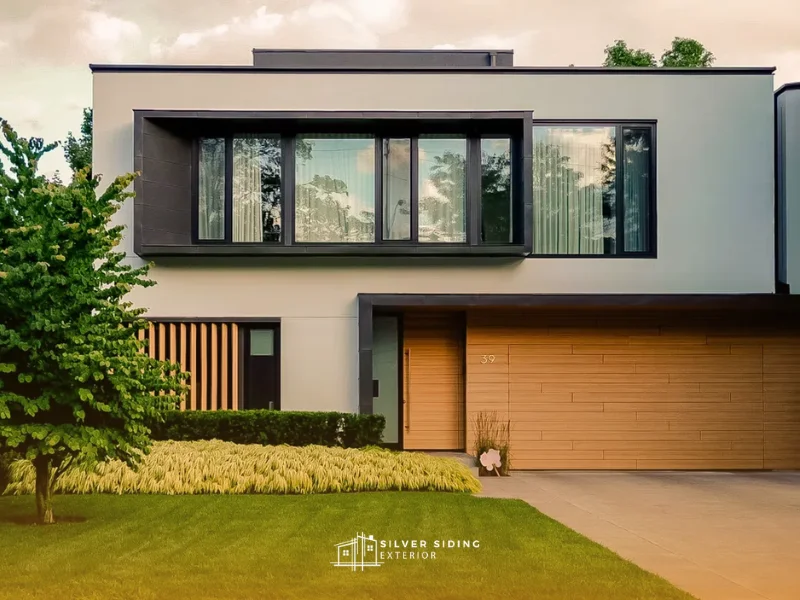
Wood-look siding delivers the appearance of natural cedar or timber using materials that behave nothing like wood: woodgrain-finished aluminum, steel and fibre cement. Modern printing and coating processes have advanced far enough that from the street the difference is often invisible.
This is arguably the fastest-growing category in 2026, and in a wet coastal climate it’s the trend with the clearest practical argument behind it.
Why wood-look finishes are trending
Warmth is back in exterior design, and nothing delivers warmth like wood. The problem is that real wood in a high-rainfall climate is a commitment — refinishing cycles, cupping, checking, rot at the terminations, and a maintenance bill that never stops.
Woodgrain metal and fibre cement solve that. You get the visual warmth that pairs with warm neutrals, stone and black window frames, with the fire performance, dimensional stability and factory finish of an engineered product.
It also solves a design problem. Full-timber facades read as heavy; woodgrain panels can be run vertically, horizontally or as a soffit-to-wall continuation without the movement issues real wood would create at those transitions.
Pros and cons of wood-look siding
+ Pros:
- Delivers cedar warmth with a fraction of the maintenance
- Excellent dimensional stability — no cupping, splitting or swelling
- Long factory finish warranties on quality metal systems
- Works vertically, horizontally and on soffits with the same product family
– Cons:
- Higher upfront cost than vinyl or basic lap siding
- Grain patterns repeat, which is noticeable at close range on cheaper products
- Requires installers experienced with concealed-fastener metal systems
- Damaged panels are replaced rather than sanded and refinished
Real cedar vs woodgrain alternatives
| Feature | Real Cedar | Woodgrain Aluminum | Woodgrain Fibre Cement |
|---|---|---|---|
| Appearance up close | Authentic, varied | Very convincing | Convincing, more uniform |
| Maintenance | High — periodic refinishing | Very low — wash only | Low |
| Wet-climate performance | ⚠️ Demanding | ✅ Excellent | ✅ Excellent |
| Dimensional stability | Moves with humidity | Very stable | Very stable |
| Relative cost | $$ – $$$ | $$$ | $$ |
| Repairability | Refinish in place | Panel replacement | Panel replacement |
Most of the wood-look facades you’ll see on modern homes here are built with one of the engineered aluminum systems, and they are not interchangeable — grain quality, profile range, fastening method and price all differ meaningfully. Our breakdown of LUX vs Longboard vs AL13 covers those differences in detail, and you can see completed examples in our project gallery.
Common mistakes with wood-look siding
- Judging grain quality from a small sample chip instead of a full-length panel, where pattern repetition becomes visible
- Mixing two different woodgrain products on one facade — the tones almost never match
- Choosing the lowest-cost woodgrain product for a wall that’s viewed at close range, like an entry soffit
- Using a woodgrain finish alongside real cedar accents, which makes the imitation obvious by comparison
Pro tip
If you want both real wood and wood-look on the same house, separate them. Put genuine cedar somewhere sheltered and viewed up close — a soffit or a recessed entry — and use woodgrain metal on the exposed field walls. Adjacent placement invites comparison; separated placement reads as a deliberate material palette.
Local Insight: Why Wood-Look Wins in a Rain Belt
This is the trend where Metro Vancouver’s climate makes the decision for you. Real cedar on an exposed west or south elevation here will demand attention on a cycle most homeowners underestimate, and the failures usually start at the end grain where water sits.
Woodgrain aluminum installed over a properly ventilated rain screen gives you the same warm, natural facade with essentially none of that exposure — which is why it has become the default recommendation for homeowners who came in asking for cedar.
Trend 8 – Mixed-Material Home Exteriors
What is mixed-material siding?
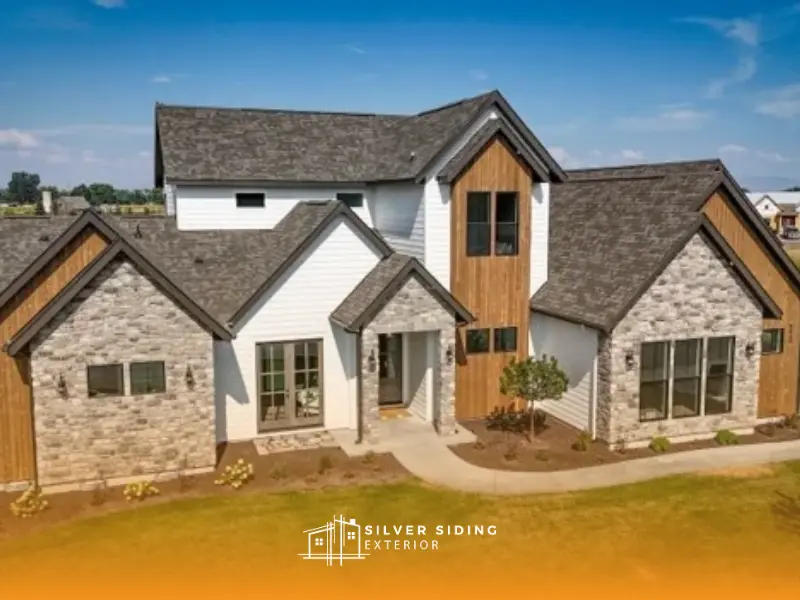
Mixed-material design combines different siding types — fibre cement, wood or wood-look, metal, stone — to create a layered, dynamic facade rather than a single uniform surface.
Instead of one material everywhere, designers blend textures and finishes strategically: smooth panel siding with warm wood accents, or metal elements introduced for contrast and structure.
Why mixed materials are trending
Homeowners are tired of flat, one-dimensional exteriors. A single material can look clean but often lacks character.
Combining materials creates contrast and depth and a genuinely custom result without overcomplicating the design. It also gives more flexibility to emphasise specific parts of the home — the entrance, upper levels, or particular architectural features.
There’s a budget argument too. Rather than applying one premium material everywhere, you can use it selectively and get most of the visual payoff for a fraction of the cost.
Pros and cons of mixed-material exteriors
+ Pros:
- Adds depth and interest without making the design feel busy
- Creates a more custom, high-end look than single-material exteriors
- Lets you highlight entrances, upper levels and feature walls
- Balances aesthetics and budget by mixing premium and standard materials
– Cons:
- Requires careful planning; arbitrary combinations look inconsistent
- More complex to install than single-material siding
- Transitions, joints and trims need precise execution
- Maintenance varies by material, so the schedule becomes uneven
Material combination ideas for modern exteriors
| Material Combination | Visual Effect | Best Use Case | Maintenance Level |
|---|---|---|---|
| Fibre cement + woodgrain metal | Warm modern contrast | Modern homes needing durability with warmth | Low |
| Metal panels + wood accents | Industrial but warm | Contemporary homes with bold lines | Medium |
| Stone siding + fibre cement | Premium and grounded | Entryways, lower levels, feature walls | Low to medium |
| ACM panels + Longboard siding | Clean luxury look | High-end modern builds | Low |
| Vinyl + wood-look accents | Budget-friendly contrast | Renovations where cost control matters | Low to medium |
This approach suits homeowners who want an exterior that feels considered rather than repetitive. It’s a strong fit for modern builds and renovations where emphasising the entrance, upper levels or a feature wall makes a disproportionate visual difference.
It’s also ideal for anyone who wants a high-end result without committing to one expensive material across the entire building.
Real homeowner insight on mixing materials
In real homeowner discussions, budget is often the driving reason:
“I saw a house with a nice cedar shingle style on the front and traditional siding on the rest… I can’t afford to do the whole house, so I’m thinking of just doing the front.”
That reflects the standard approach — premium materials where they’re seen, cost-effective materials everywhere else, without compromising the overall design.
Common mistakes with mixed materials
- Mixing too many materials without a plan, producing clutter rather than intent
- Combining materials that don’t complement each other visually or age at different rates
- Ignoring how materials expand, contract and react to moisture, creating long-term problems at transitions
- Using premium materials in small, random sections, which reads as inconsistent rather than high-end
- Failing to plan transitions properly, resulting in visible gaps and uneven finishes
Pro tip
Plan the transitions first, not last. Where materials meet — corners, edges, joints — has a bigger impact on the final look than the materials themselves. A clean transition makes simple materials look expensive; poor detailing ruins premium ones. This is why experienced installers begin with layout and transition planning before anything goes on the wall.
Local Insight: Mixing Materials in a Rain-Driven Climate
Mixed-material exteriors in Metro Vancouver have to be planned around moisture from the first drawing, not the last. Each material absorbs, sheds and expands differently under constant rain, so the transitions between them become the weak point long before the materials themselves do.
Pairing wood or wood-look accents with a durable base like fibre cement, and installing the whole assembly over a proper rain screen system, is what keeps a layered facade from aging unevenly.
Trend 9 – Accent-Driven Siding Design
What is accent-driven siding design?
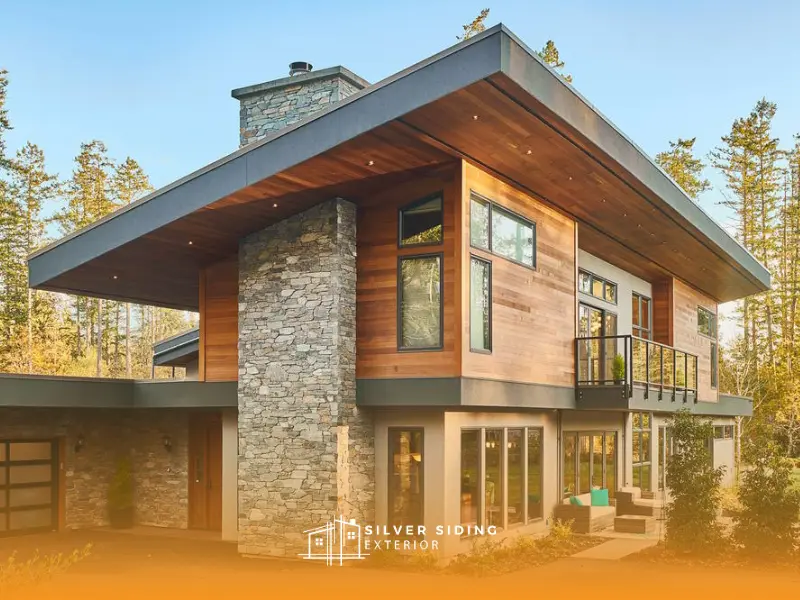
Accent-driven design applies siding materials to specific, targeted areas rather than uniformly across a facade. Key sections — entryways, rooflines, vertical volumes, architectural features — are highlighted with contrasting materials, colors or textures.
The goal isn’t to add more. It’s to use less, more intelligently, creating impact through placement rather than quantity.
Why accent-driven design is trending
Homeowners have moved away from fully uniform exteriors toward more intentional, design-led solutions.
Rather than using expensive or bold materials everywhere, this approach highlights the areas that matter — entrances, rooflines, vertical sections — while keeping the rest simple and cost-effective.
It also aligns with current architectural thinking, where contrast and focal points do the heavy lifting. And practically, it’s the smartest balance of aesthetics and budget available: real visual impact without the cost of premium materials across an entire building.
Pros and cons of accent-driven siding
+ Pros:
- Creates strong visual interest without overwhelming the design
- Highlights key architectural features
- Far more cost-effective than full-coverage premium materials
- Offers controlled flexibility in combining colors and textures
– Cons:
- Requires thoughtful planning; random placement looks unbalanced
- Too many accent areas dilute the effect
- Poor transitions between materials undermine the finish
- Under-scaled accents can leave the design feeling unfinished
Full coverage vs accent-driven siding
| Feature | Full Coverage Siding | Accent-Driven Siding |
|---|---|---|
| Visual Style | Uniform / Consistent | Dynamic / Focused |
| Design Impact | Subtle | High in key areas |
| Material Usage | Same material throughout | Selective material use |
| Cost Efficiency | Less planning flexibility | More cost control |
| Design Complexity | Simpler | Requires thoughtful planning |
| Overall Feel | Balanced / Traditional | Modern / Intentional |
Common mistakes with accent-driven design
- Placing accents arbitrarily instead of on genuine architectural features
- Using too many accent zones, which reduces overall impact
- Choosing materials or colors that don’t create enough separation
- Ignoring transitions, leading to visible seams and uneven finishes
- Overusing accents until the design feels busy rather than intentional
Pro tips for accent-driven siding
- Start with a focal point. Decide where the eye should go first — entryway, upper section, feature wall — and build the strategy around it.
- Limit your accent zones. One or two well-placed areas always look more deliberate than accents spread across the facade.
- Use contrast wisely. The goal is separation, not chaos. Accents should stand out but stay cohesive with the main field.
- Keep transitions clean. Edges, trims and alignment matter more than the material — this is what reads as high-end.
- Think balance, not symmetry. Accents don’t need to mirror each other, but they should feel visually settled across the elevation.
Local Insight: Why Accents Work Well in This Region
Accent-driven design suits Metro Vancouver particularly well, because homes here sit against a lot of natural context. Subtle contrast around an entry or upper section lets a house stand out without fighting the landscape or the neighbouring properties.
There’s a maintenance argument too: keeping sensitive materials like natural wood confined to small, sheltered areas dramatically reduces upkeep in a climate with this much rain.
Trend 10 – Sustainable and Low-Maintenance Siding
What is sustainable siding?
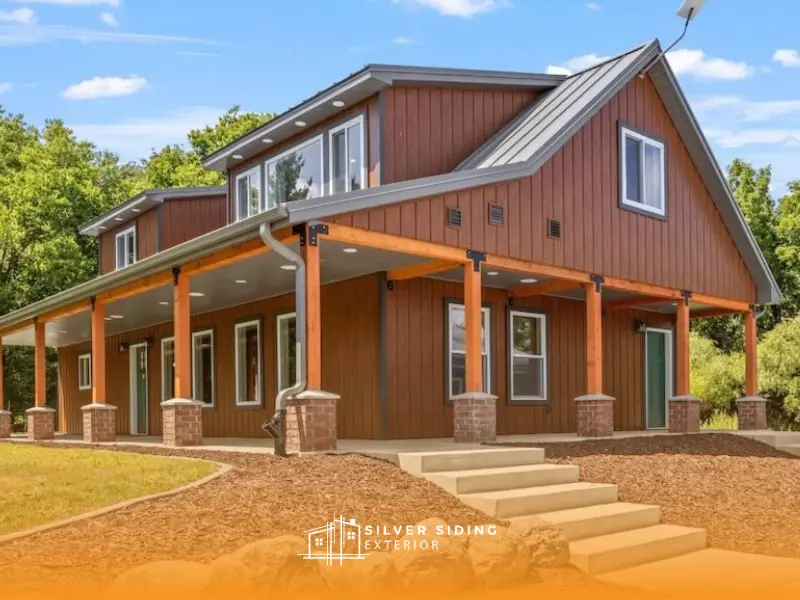
Sustainable siding means exterior materials and assemblies designed to reduce environmental impact while maintaining long-term durability and performance.
That includes recyclable materials, responsibly sourced products, and systems engineered to last longer with minimal maintenance. The point isn’t to be “green” on installation day — it’s to reduce waste, repairs and replacements over decades.
In practice, sustainable siding also improves energy performance, because it works as part of a well-designed exterior assembly that manages temperature and moisture together.
Why sustainable siding is trending in 2026
Homeowners are increasingly thinking past appearance toward long-term impact — environmental and financial at the same time.
Many are simply looking for materials that last longer, need less attention, and don’t require replacement on a short cycle. That leads naturally to more sustainable choices even among people who aren’t specifically trying to go green.
Awareness around energy efficiency is growing too. A well-designed exterior assembly improves insulation and moisture control, reducing both environmental impact and long-term energy costs.
Meanwhile, sustainable materials have improved enormously in design terms, so homeowners no longer trade aesthetics for durability.
Pros and cons of sustainable siding
+ Pros:
- Longer lifespan, reducing replacement frequency
- Lower maintenance over time depending on material
- Improves energy efficiency as part of a designed system
- Often recyclable or responsibly sourced
- Reduces long-term environmental impact
– Cons:
- Higher upfront cost than basic siding options
- Some materials require specialised installation
- Not all eco-labelled options perform well in harsh climates
- Regional availability can be limited
Sustainable vs traditional siding compared
| Feature | Traditional Siding | Sustainable Siding |
|---|---|---|
| Lifespan | Moderate | Long-lasting |
| Maintenance | Moderate to high | Low to moderate |
| Environmental Impact | Higher | Lower |
| Energy Efficiency | Basic | Improved when system-based |
| Upfront Cost | $ – $$ | $$ – $$$ |
| Long-Term Value | Moderate | Higher |
Common mistakes with sustainable siding
- Focusing on the eco-friendly label without checking real-world performance and durability
- Choosing materials unsuited to the local climate, leading to faster wear and higher maintenance
- Ignoring the full assembly — insulation, air barrier, moisture control — which undermines the whole approach
- Cutting upfront cost too aggressively and ending up with materials that don’t last
- Failing to plan for the different maintenance profiles of each material
Pro tips for sustainable siding
- Think in systems, not materials. Sustainable siding performs best combined with proper insulation, air barriers and moisture control — never as a standalone product choice.
- Prioritise durability over trend. The most sustainable option is usually the one that lasts longest with the least intervention, even at a higher upfront cost.
- Check real maintenance requirements. Some eco-friendly materials still need regular upkeep; understand the commitment before you commit.
- Match materials to your climate. A product that performs well in a dry region may behave completely differently in a high-moisture environment like Metro Vancouver.
- Plan for aging, not installation. Consider how the material weathers, how it reacts to sustained rain, and how easily it can be repaired.
That trade-off between how a material looks and how it performs under constant rain is worth working through properly before you commit. We compared the three materials homeowners here shortlist most often in metal, vinyl and fibre cement siding in a wet climate, including how each handles moisture, movement and long-term maintenance.
Local Insight: What Sustainability Actually Means in a Wet Climate
In Metro Vancouver, siding that needs frequent repair or early replacement is not sustainable, regardless of what the product literature says. The most environmentally sound choice here is usually the one that resists moisture, mould and warping long enough that nobody has to touch it again for decades.
That’s why durability and low maintenance are treated as sustainability criteria in this region, not as separate considerations.
Final Thoughts on Modern Siding Trends in 2026
Choosing siding in 2026 is no longer purely an appearance decision. It’s a balance between design, durability and long-term performance — and the three are more connected than most product marketing admits.
The direction is consistent across every trend above:
- warmer, more grounded color
- cleaner lines and larger, simpler profiles
- smarter material combinations rather than uniform facades
- and materials selected for how they perform in real conditions, not just how they photograph
What matters isn’t following every trend. It’s understanding which approach fits your home, your climate and how long you plan to stay.
If your shortlist has come down to a material rather than a look, that’s the right next question to answer. Our breakdown of metal vs. vinyl vs. fibre cement siding in a wet climate covers how each performs under sustained rain, what maintenance realistically looks like, and where each option stops making sense.
A well-planned exterior shouldn’t just look good today. It should still perform, and still hold its value, a decade from now.
